Two satellite constellations, one national space ambition
At the 77th International Astronautical Congress (IAC 2026), held in Antalya on 5–9 October, Turkey showcased its growing ambitions to develop sovereign space capabilities, combining government-backed programs, private investment and domestic industrial expertise.
🛰️ Two particularly significant initiatives:
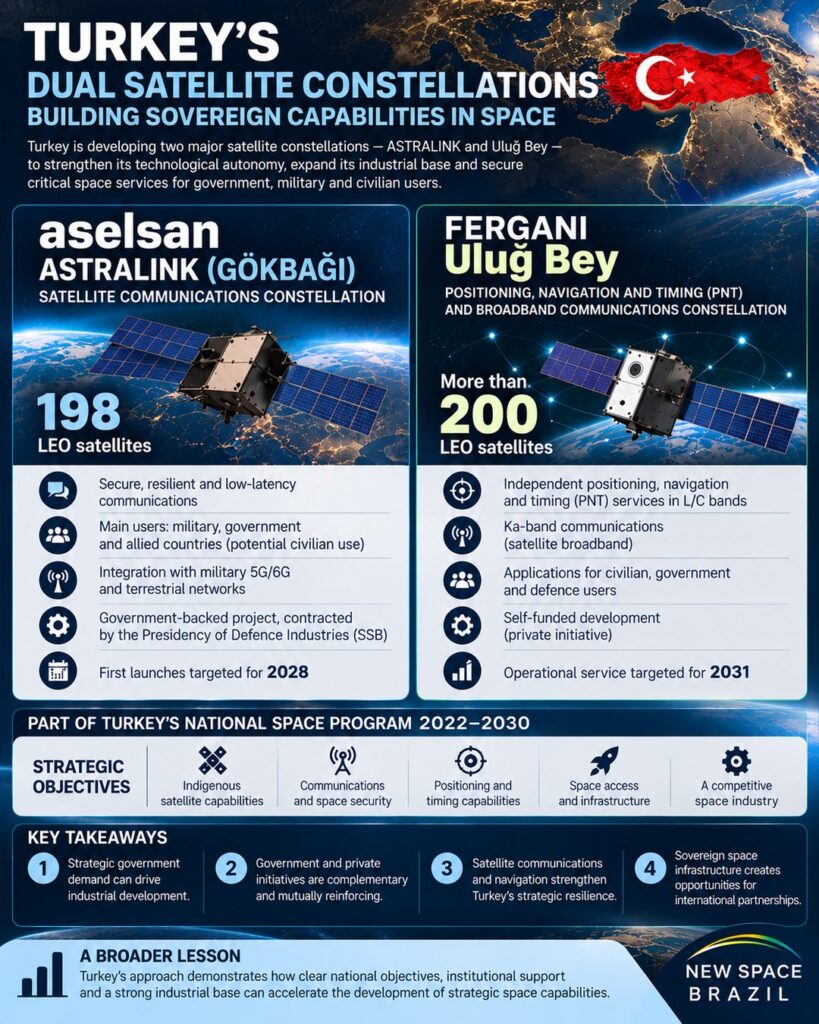
🔹 ASELSAN – ASTRALINK (GÖKBAĞI): A planned constellation of 198 Low Earth Orbit (LEO) satellites designed to provide secure, resilient communications for military, government and potentially civilian users. The system envisages integration with terrestrial 5G/6G networks, with initial launches targeted for 2028.
🔹 Fergani Space – Uluğ Bey: A privately developed constellation of more than 200 LEO satellites, combining independent positioning, navigation and timing (PNT) services with Ka-band broadband communications. Operational service is targeted for 2031.
🌍 Beyond satellite constellations
Other developments highlighted around IAC 2026 included Turkey’s planned spaceport in Somalia, progress in indigenous satellite manufacturing and growing capabilities in space access and infrastructure. What makes these initiatives particularly interesting is the industrial strategy behind them.
The two constellations represent different development models: ASTRALINK is backed by government defense requirements, while Uluğ Bey is being developed through private investment. Although they are separate programs, both contribute to a broader national objective of technological independence, industrial competitiveness and reduced reliance on foreign space infrastructure.
💡 A broader lesson for emerging space nations:
Clearly defined national requirements, government procurement, private-sector innovation and industrial capabilities can reinforce one another, transforming strategic ambitions into concrete space programs and potentially sustainable commercial markets.
📊 Our accompanying infographic compares the two initiatives and highlights their strategic significance.
Originally published on LinkedIn.