
Global spaceports series | Chapter 09/10 — Sovereign Hubs in transition
Following our examination of Southern Hemisphere launch opportunities, New Space Brazil continues its 10-part Global Spaceports Series, exploring how geography, infrastructure, and national strategies shape access to orbit.
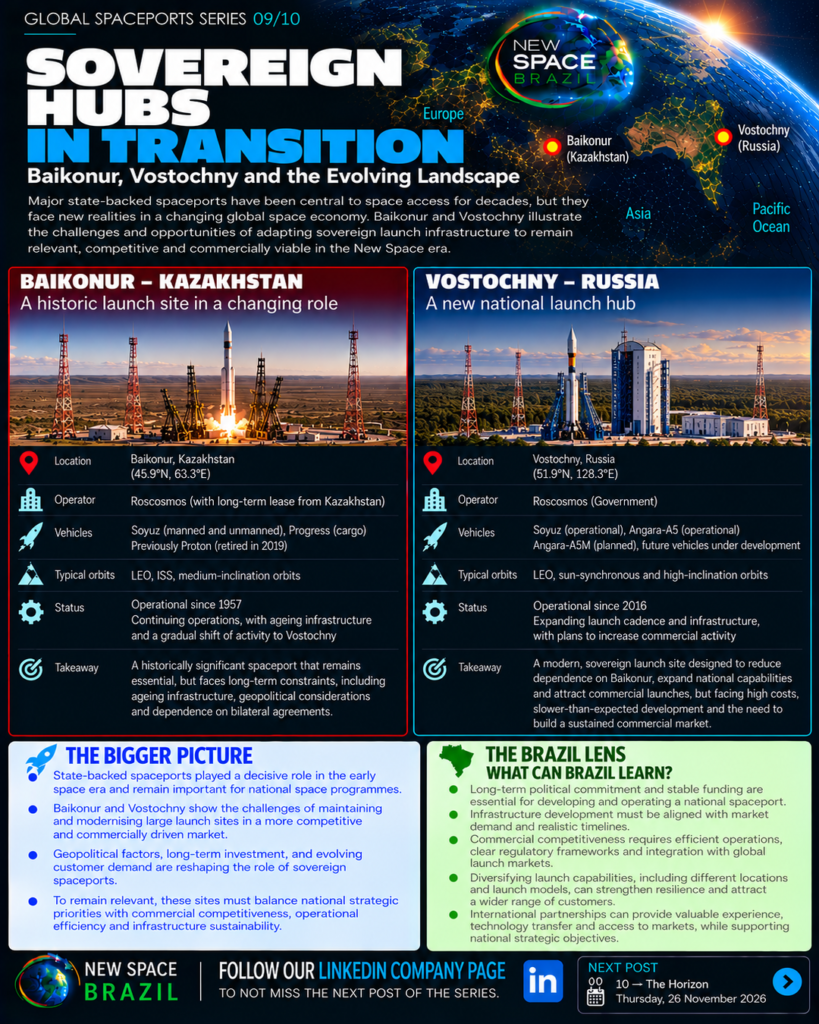
🚀 BAIKONUR, VOSTOCHNY AND THE EVOLVING LANDSCAPE
For decades, access to space was largely determined by governments investing in major national launch facilities.
Today, the emergence of commercial launch providers, new spaceports, and increasingly competitive launch services is challenging the traditional model of state-backed infrastructure.
Russia’s Baikonur and Vostochny spaceports illustrate how sovereign launch capabilities must adapt to changing geopolitical, technological, and commercial realities.
Two contrasting examples highlight this transition:
📍 Baikonur — Kazakhstan: A Historic Launch Centre
Established in 1955, Baikonur became the birthplace of the space age, hosting Sputnik 1 in 1957 and Yuri Gagarin’s historic flight in 1961.
Located in Kazakhstan but operated by Russia under a long-term lease, Baikonur remains an important facility for Soyuz launches, including crewed and cargo missions to the International Space Station.
However, ageing infrastructure, geopolitical considerations, and dependence on bilateral agreements create long-term challenges.
Its future illustrates the difficulty of maintaining strategically important legacy infrastructure while adapting to evolving operational requirements.
📍 Vostochny — Russia: Building Sovereign Independence
Developed to reduce Russia’s dependence on Baikonur, Vostochny began operations in 2016.
The spaceport supports Soyuz launches and has introduced Angara-A5 capabilities, with further infrastructure development and vehicle upgrades planned.
Vostochny represents a substantial investment in sovereign access to space, but its development also demonstrates the challenges of establishing a new launch centre: high infrastructure costs, lengthy construction programmes, and the need to achieve sustainable launch activity.
Its long-term success will depend on balancing national strategic objectives with operational efficiency and commercial opportunities.
🌐 THE BIGGER PICTURE
Sovereign access to space and commercial competitiveness are related objectives — but they are not the same.
National spaceports provide strategic independence, support defence and scientific programmes, and maintain critical technological capabilities.
However, large public investments do not automatically produce internationally competitive launch services.
Baikonur and Vostochny demonstrate that infrastructure must evolve alongside launch technologies, customer requirements, geopolitical conditions, and market competition.
The challenge is to balance national strategic priorities with operational efficiency, sustainable investment, and sufficient launch demand.
🇧🇷 THE BRAZIL LENS — WHAT CAN BRAZIL LEARN?
Developing a national launch capability requires more than constructing and maintaining a launch centre.
Brazil can draw several lessons from the experience of major sovereign spaceports.
Long-term political commitment and predictable investment are important, but infrastructure development must also be aligned with realistic launch demand and clearly defined strategic objectives.
Rather than concentrating exclusively on Alcântara, Brazil should evaluate its broader launch requirements, including the potential role of complementary locations, different launch technologies, and partnerships with established commercial operators.
The objective should be a sustainable national launch ecosystem that serves both Brazil’s strategic interests and identifiable commercial markets.
📅 NEXT IN THE SERIES — THE FINAL INSTALMENT
Post 10 — The Horizon
Thursday, 26 November 2026
Our concluding analysis will bring together the lessons from the global spaceport network, examining infrastructure bottlenecks, regulatory challenges, emerging technologies, and the future of commercial access to space.
We will also revisit the central question for Brazil: what kind of national launch strategy can turn geographical and technological potential into a sustainable space economy?
Originally published on Linkedin.