
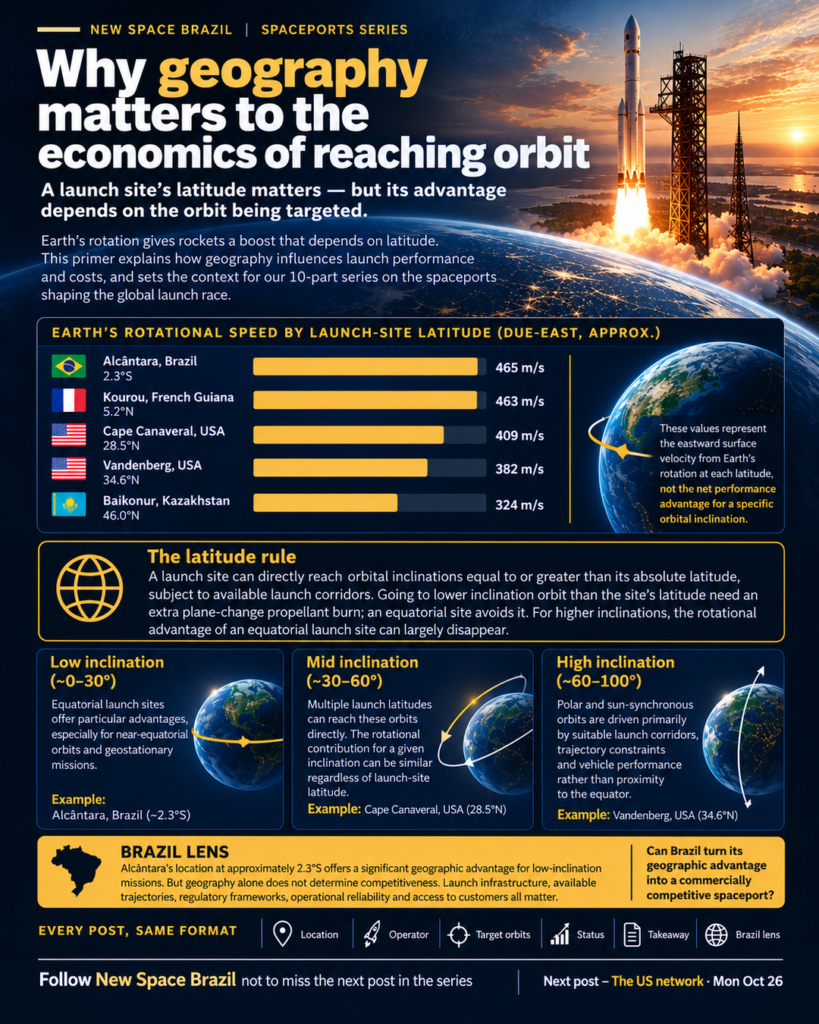
Global Spaceport Series | Primer – Why geography matters to the economics of reaching orbit?
🌍 Does launching a rocket closer to the equator always provide a competitive advantage?
Not necessarily.
A launch site’s latitude influences the contribution of Earth’s rotation to a rocket’s velocity. But the actual benefit depends on the orbital inclination being targeted, the available launch trajectories and the mission’s requirements.
For low-inclination orbits, equatorial locations can offer significant advantages. For higher-inclination missions, however, much of that advantage can disappear. And geography is only part of the equation.
⚙️ Launch infrastructure, operational reliability, regulatory frameworks, range safety, logistics and access to customers all play important roles in determining a spaceport’s commercial competitiveness.
🇧🇷 What does this mean for Brazil?
Located approximately 2.3° south of the equator, Alcântara enjoys a favourable geographic position for low-inclination launches.
But an important question remains:
Can Brazil translate this geographic advantage into a commercially competitive and internationally relevant spaceport?
That question will feature throughout our 10-part Spaceports Series as we examine launch infrastructure, orbital access and the strategies being pursued around the world.
📊 Today’s infographic introduces the fundamentals of latitude, Earth’s rotational velocity and orbital inclination that will help frame the installments ahead.
📅 NEXT: Monday, October 26 — The US Network
Florida, Vandenberg and Starbase: three very different approaches to accessing orbit.
👉 Follow New Space Brazil for the next instalment and our continuing coverage of the global space economy.