
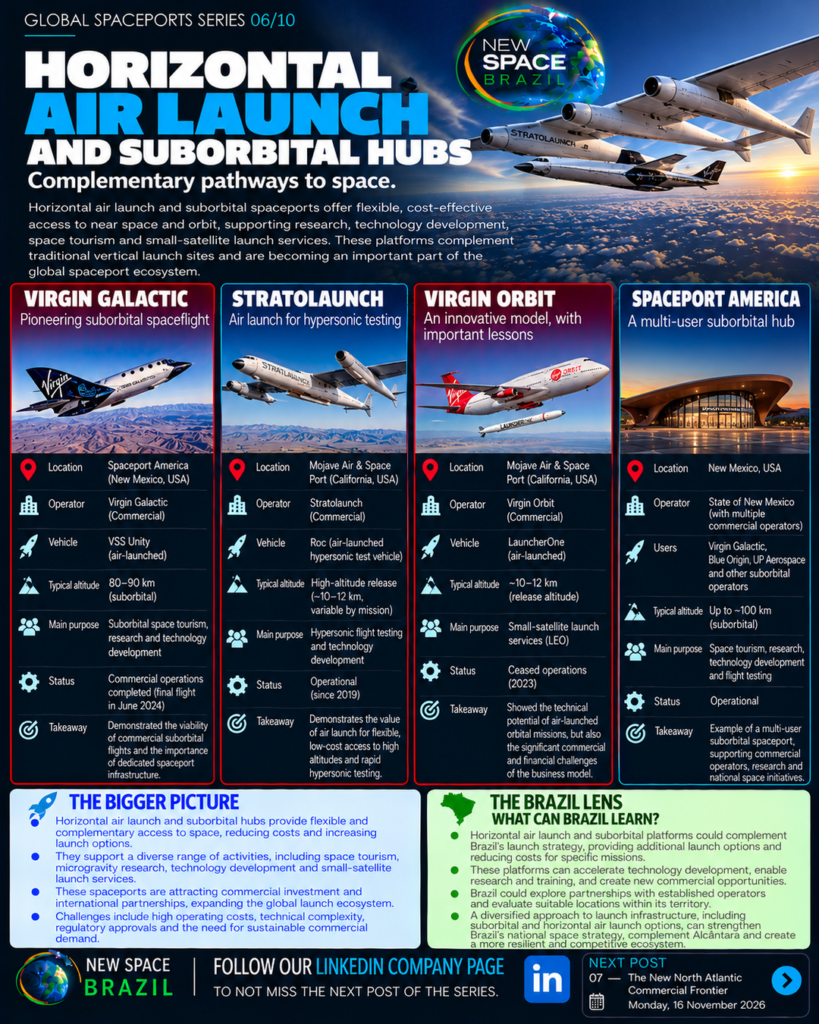
Global Spaceports Series | Chapter 06/10 — Horizontal Air Launch And Suborbital Hubs
🌍🚀 GLOBAL SPACEPORTS SERIES | POST 06/10 — HORIZONTAL AIR LAUNCH AND SUBORBITAL HUBS
Following our examination of India’s and the Asia-Pacific region’s expanding launch infrastructure, New Space Brazil continues its 10-part Global Spaceports Series, exploring how geography, technology, and operating models shape access to space.
✈️ HORIZONTAL AIR LAUNCH AND SUBORBITAL HUBS — ALTERNATIVE PATHWAYS TO SPACE
Not every space mission begins with a rocket launching vertically from a traditional spaceport.
Air-launched vehicles and runway-based space operations offer alternative approaches, supporting suborbital research, technology testing, space tourism, and, in some cases, orbital satellite deployment.
Four examples illustrate both the opportunities and limitations of these models:
📍 Virgin Galactic — Suborbital Spaceflight: Operating from Spaceport America in New Mexico, Virgin Galactic demonstrated commercial suborbital flights using its air-launched VSS Unity spaceplane. Unity completed its final commercial flight in June 2024, with the company pursuing a new generation of Delta-class vehicles.
📍 Stratolaunch — Hypersonic Testing: Based at Mojave Air & Space Port in California, Stratolaunch uses its enormous Roc carrier aircraft to support air-launched hypersonic testing. Its current focus is flight testing and technology development rather than operational orbital satellite launches.
📍 Virgin Orbit — The Commercial Challenge: Virgin Orbit demonstrated orbital satellite launches using LauncherOne, released from a modified Boeing 747. Despite achieving successful missions, the company ceased operations in 2023, illustrating the financial and commercial challenges of sustaining an air-launch business.
📍 Spaceport America — A Multi-User Suborbital Hub: Developed in New Mexico, Spaceport America provides dedicated infrastructure for commercial aerospace operations, research, flight testing, and suborbital activities, demonstrating the potential role of specialised spaceports beyond conventional orbital launches.
🌐 THE BIGGER PICTURE
Technical innovation does not automatically translate into commercial success.
Horizontal air launch can offer operational flexibility and reduce dependence on traditional ground-launch infrastructure, but it also introduces aircraft integration, payload limitations, and specialised operating costs.
Suborbital platforms serve different markets, including microgravity research, hypersonic testing, astronaut training, and tourism.
Virgin Orbit’s experience highlights a fundamental lesson: a technically viable launch system still requires sufficient demand, competitive economics, and sustainable financing.
The future of these alternative approaches will depend on their ability to serve clearly defined markets rather than simply replicate conventional launch services.
🇧🇷 THE BRAZIL LENS — WHAT CAN BRAZIL LEARN?
Brazil’s space infrastructure strategy need not be limited to conventional vertical-launch facilities.
Air-launch and suborbital capabilities could create opportunities for aerospace research, technology validation, hypersonic testing, and specialised commercial services.
However, the experience of Virgin Orbit demonstrates the importance of identifying customers and sustainable business models before committing substantial investment.
For Brazil, the priority should be matching infrastructure and technology choices to demonstrable market demand, while exploring opportunities to leverage existing aerospace capabilities and international partnerships.
📅 NEXT IN THE SERIES
Chapter 07 — The New North Atlantic Commercial Frontier
Monday, 16 November 2026
How emerging high-latitude spaceports in Norway, the United Kingdom, Canada, and the Azores are seeking to expand commercial access to polar and sun-synchronous orbits.
Originally published on Linkedin