
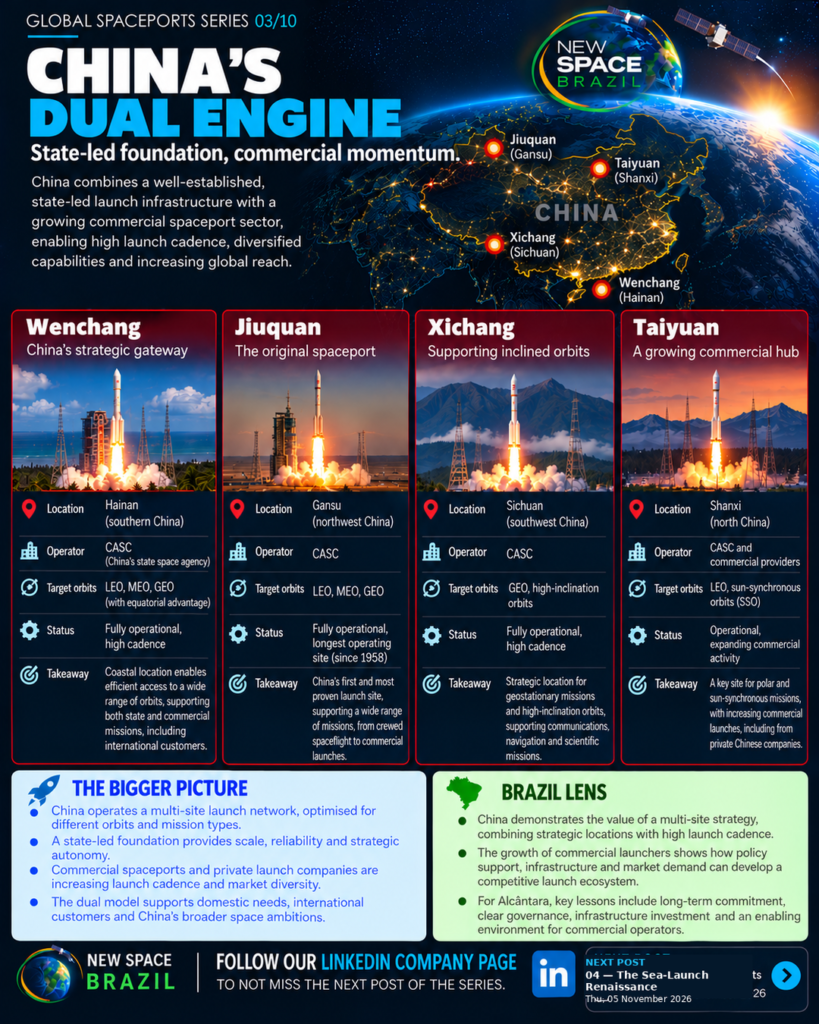
Global SPACEPORTS Series | Chapter 03/10 — China’s Dual Engine
Following our examination of Europe’s institutional launch model, New Space Brazil continues its 10-part Global Spaceports Series, exploring how geography, infrastructure, and national strategies shape access to orbit.
🇨🇳 CHINA’S DUAL ENGINE — STATE-LED FOUNDATION, COMMERCIAL MOMENTUM
China has developed one of the world’s most extensive launch infrastructures, combining established state-led spaceports with a rapidly expanding commercial launch sector.
Unlike the US model, where commercial operators have become dominant providers of launch services, China’s approach builds on decades of government investment while increasingly encouraging private companies and dedicated commercial infrastructure.
Four established launch locations illustrate the geographical diversity of China’s network:
📍 Hainan — Wenchang: China’s southernmost major launch centre, offering advantageous trajectories for low-inclination and high-energy missions. Hainan also hosts a separate commercial spaceport, illustrating the emerging relationship between state and commercial launch infrastructure.
📍 Gansu — Jiuquan: China’s oldest satellite launch centre and its principal human spaceflight launch site, supporting crewed missions, satellite deployments, and commercial launch activity.
📍 Sichuan — Xichang: A major centre for communications, navigation, and other satellite missions, with established capabilities for launches towards geostationary transfer orbit.
📍 Shanxi — Taiyuan: Specialising in polar and sun-synchronous missions, particularly relevant for Earth observation, remote sensing, and satellite constellations.
🌐 THE BIGGER PICTURE
China’s space strategy demonstrates how state investment and commercial competition can develop in parallel.
Its established launch infrastructure provides strategic autonomy, technical experience, and operational scale.
Meanwhile, commercial launch companies and dedicated facilities, particularly on Hainan Island, are creating new opportunities for launch services and technological innovation.
The distinguishing feature is not simply the number of launch sites, but China’s effort to integrate national strategic objectives, industrial policy, and commercial development into a broader space ecosystem.
🇧🇷 THE BRAZIL LENS — WHAT CAN ALCÂNTARA LEARN?
China’s experience highlights the importance of long-term institutional commitment combined with an enabling environment for commercial operators.
For Alcântara, the challenge is to translate its geographical advantage into sustainable launch activity through infrastructure, regulatory clarity, investment, and customer demand.
📅 NEXT IN THE SERIES
Post 04 — The Sea-Launch Renaissance
Thursday, 5 November 2026
Why launching rockets from ocean-based platforms is attracting renewed interest — and what flexibility in launch location could mean for the global space industry.
Originally published on Linkedin.