
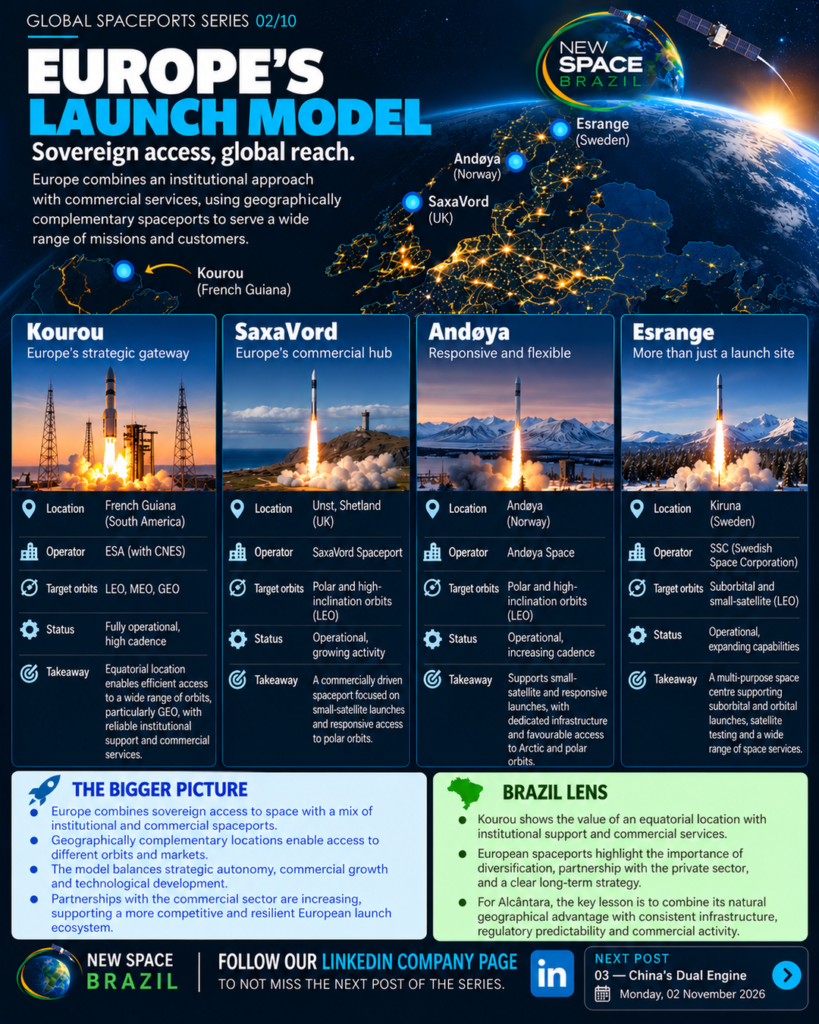
Global Spaceport Series | Chapter 02/10 — Europe’s Launch Model
Following our examination of the United States’ diversified spaceport network, New Space Brazil continues its 10-part Global Spaceports Series, exploring how geography, infrastructure, and institutional models shape access to orbit.
🇪🇺 EUROPE’S LAUNCH MODEL — SOVEREIGN ACCESS, GLOBAL REACH
Europe has developed a distinctive approach to space access, combining institutional investment, strategic autonomy, and an expanding commercial launch sector.
At its centre is Kourou, in French Guiana, supported by European institutions and industry. Meanwhile, emerging spaceports in northern Europe are opening new opportunities for small-satellite launches and polar missions.
Four locations illustrate this evolving model:
📍 French Guiana — Guiana Space Centre (Kourou): Europe’s principal orbital launch hub, operated by CNES with ESA support and launch services provided by Arianespace and other operators. Its near-equatorial location offers advantages for eastward launches, particularly towards geostationary transfer orbit.
📍 United Kingdom — SaxaVord Spaceport (Shetland): A commercially developed launch facility targeting polar and sun-synchronous missions, reflecting the UK’s ambition to establish domestic vertical-launch capabilities.
📍 Norway — Andøya Spaceport: Building on decades of sounding-rocket experience, Andøya is developing orbital launch capabilities for small satellites, with access to polar and high-inclination trajectories.
📍 Sweden — Esrange Space Center: Operated by the Swedish Space Corporation (SSC), Esrange combines established sounding-rocket and research operations with infrastructure development for future orbital launches.
🌐 THE BIGGER PICTURE
Europe’s approach demonstrates that independent access to space is both a strategic capability and an industrial policy choice.
Kourou’s institutional foundations have supported Europe’s sovereign launch ambitions for decades. The emergence of additional commercial spaceports reflects growing demand for flexibility, dedicated launches, and access to different orbital inclinations.
The challenge is to combine institutional support with commercial competitiveness, technological innovation, and a sustainable launch cadence.
🇧🇷 THE BRAZIL LENS — WHAT CAN ALCÂNTARA LEARN?
Kourou demonstrates how a favourable equatorial location can become a strategic asset when supported by long-term institutional commitment, infrastructure investment, and commercial launch operators.
For Alcântara, the opportunity lies in turning its geographical advantage into a reliable, competitive launch service supported by a clear national strategy.
📅 NEXT IN THE SERIES
Post 03 — China’s Dual Engine
Monday, 2 November 2026
How China combines state-led launch infrastructure with emerging commercial spaceports, particularly on Hainan Island.
Originally published on Linkedin.