
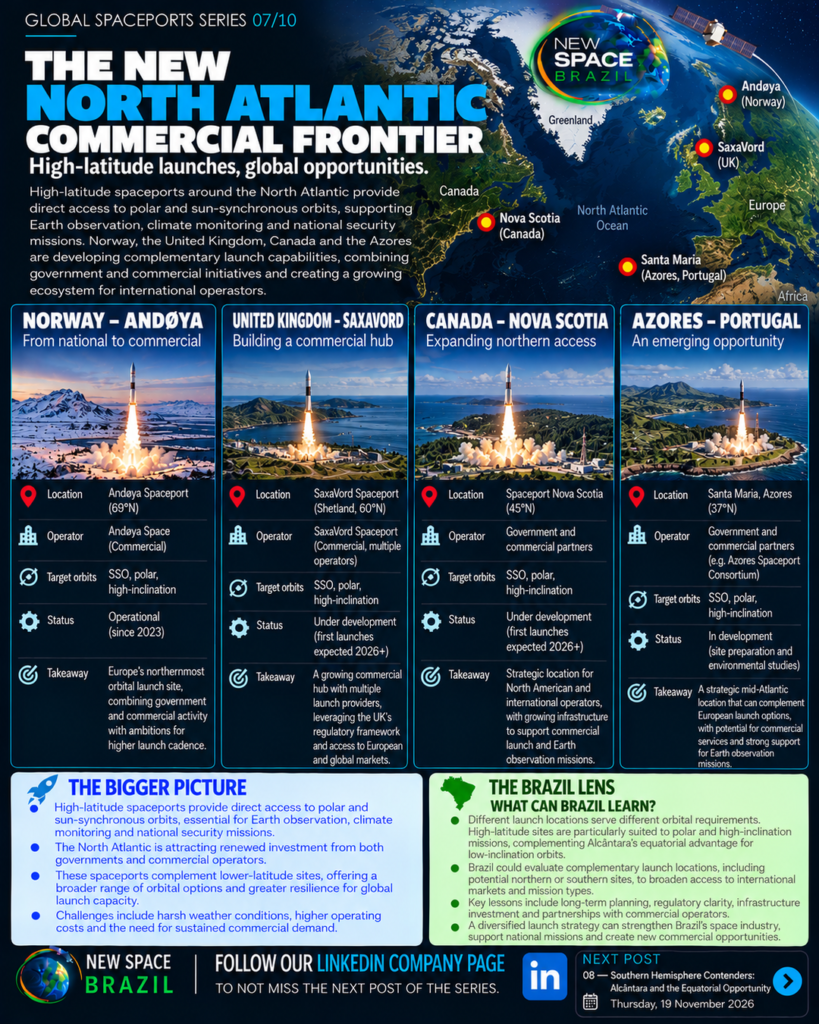
Global spaceports series | Chapter 07/10 — The new North Atlantic commercial frontier
Following our examination of horizontal air launch and suborbital hubs, New Space Brazil continues its 10-part Global Spaceports Series, exploring how geography, infrastructure, and commercial strategies shape access to orbit.
🌐 THE NORTH ATLANTIC — HIGH-LATITUDE ACCESS, COMMERCIAL OPPORTUNITIES
The North Atlantic is emerging as a new frontier for commercial spaceports, with projects seeking to serve growing demand for polar, sun-synchronous, and high-inclination satellite missions.
Unlike established launch centres built primarily around national programmes, several of these initiatives aim to attract commercial operators and international customers.
Four locations illustrate this evolving landscape:
📍 Norway — Andøya Spaceport: Building on decades of sounding-rocket experience, Andøya is developing commercial orbital launch capabilities. Its Arctic location offers favourable access to polar and sun-synchronous trajectories, with opportunities for dedicated small-satellite missions.
📍 United Kingdom — SaxaVord Spaceport: Located in the Shetland Islands, SaxaVord is positioning itself as a commercial vertical-launch hub, seeking to accommodate multiple launch providers and serve European and international satellite customers.
📍 Canada — Spaceport Nova Scotia: A commercial spaceport project on Canada’s Atlantic coast, aiming to provide launch infrastructure for small and medium-sized vehicles targeting polar and high-inclination orbits.
📍 Portugal — Santa Maria, Azores: The Azores represent an emerging Atlantic space opportunity, with initiatives exploring spaceport infrastructure and commercial launch services alongside the region’s broader space-related activities.
🌐 THE BIGGER PICTURE
The emergence of North Atlantic spaceports reflects a growing recognition that launch geography is a strategic commercial asset.
High-latitude locations can offer favourable trajectories for polar and sun-synchronous missions, particularly relevant to Earth observation, climate monitoring, and national security.
However, geographical advantages alone are insufficient.
These projects must overcome challenges involving infrastructure investment, harsh operating conditions, regulatory approvals, launch safety, and — critically — sufficient customer demand.
Their long-term success will depend on whether they can translate location advantages into reliable, commercially competitive launch services.
🇧🇷 THE BRAZIL LENS — WHAT CAN BRAZIL LEARN?
Different orbital requirements may justify different launch locations.
While Alcântara offers advantages for low-inclination missions, the North Atlantic experience raises an important strategic question: should Brazil evaluate complementary launch sites better suited to polar and high-inclination trajectories?
The lesson is not necessarily to build more spaceports, but to develop a national launch infrastructure strategy driven by orbital demand, geography, economics, and commercial viability.
📅 NEXT IN THE SERIES
Post 08 — Southern Hemisphere Contenders: Alcântara and the Equatorial Opportunity
Thursday, 19 November 2026
A closer examination of Brazil’s launch potential alongside New Zealand and Australia — and how Southern Hemisphere geography could influence the future of commercial access to space.
Originally published on Linkedin