
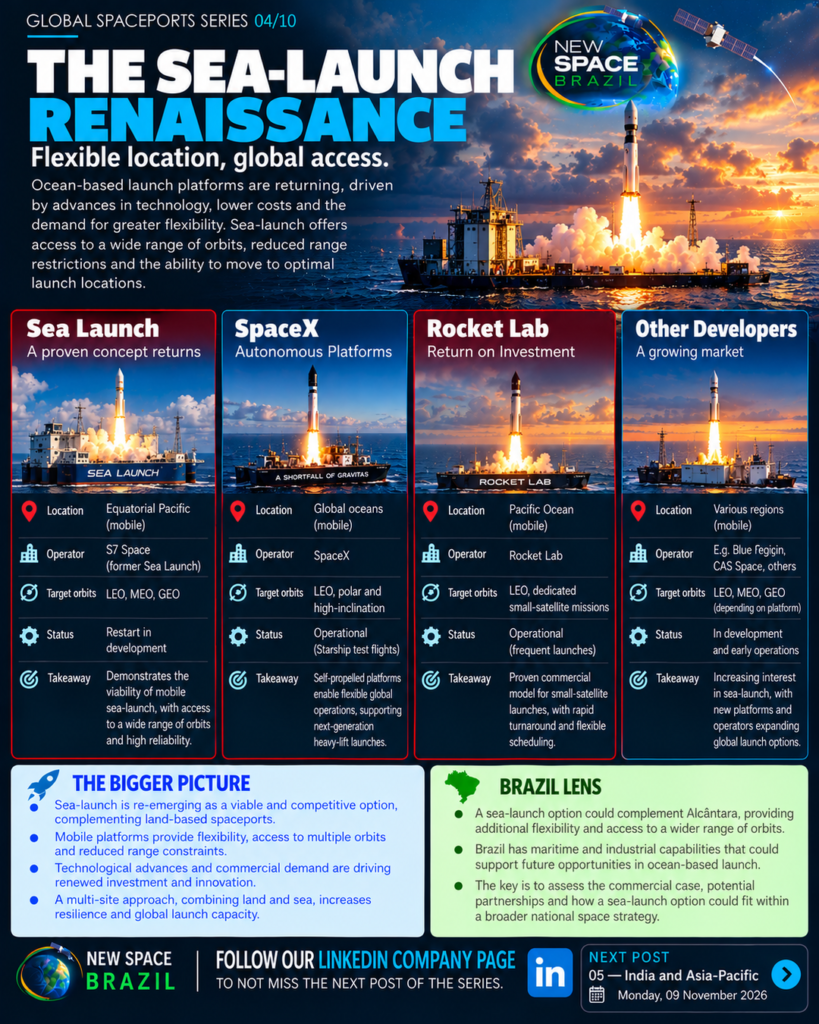
Global Spaceports Series | Chapter 04/10 — The Sea-Launch Renaissence
Following our examination of China’s state-led and commercial launch infrastructure, New Space Brazil continues its 10-part Global Spaceports Series, exploring how geography, technology, and operating models shape access to orbit.
🌊 THE SEA-LAUNCH RENAISSANCE — FLEXIBLE LOCATION, GLOBAL ACCESS
What if a spaceport could move to a more favourable launch location rather than being constrained by geography?
Ocean-based launch platforms offer an alternative to traditional land-based spaceports, potentially providing greater flexibility in launch latitude, orbital trajectories, and range safety.
The concept is not new. But renewed commercial interest, modern launch technologies, and the growing satellite market are bringing maritime space operations back into focus.
Four examples illustrate different aspects of this evolution:
📍 Sea Launch — Odyssey Platform: A pioneering commercial venture that launched Zenit rockets from a mobile platform near the equator in the Pacific Ocean. Its last launch took place in 2014, demonstrating both the technical feasibility and commercial challenges of offshore launch operations.
📍 China — Offshore Launch Platforms: China has established operational sea-launch capabilities, particularly for solid-fuel rockets launched from maritime platforms off its eastern coast. This is one of the clearest contemporary examples of orbital launches conducted at sea.
📍 SpaceX — Autonomous Drone Ships: SpaceX has transformed maritime rocket recovery through autonomous landing platforms. Although these vessels do not launch rockets, they demonstrate how offshore infrastructure can support reusable launch operations and high launch cadence.
📍 Rocket Lab — Maritime Recovery: Rocket Lab has explored ocean-based recovery of Electron rocket boosters. While its orbital launches remain land-based, its experience illustrates the potential role of maritime operations in reusable launch systems.
🌐 THE BIGGER PICTURE
Sea-based launch offers flexibility, but mobility does not automatically translate into lower costs.
Offshore platforms can provide access to alternative launch trajectories, potentially reducing certain geographical and range-safety constraints.
However, maritime logistics, weather, platform stability, regulatory requirements, and operating costs introduce their own challenges.
The commercial opportunity depends on whether these advantages outweigh the complexity of operating at sea.
🇧🇷 THE BRAZIL LENS — WHAT COULD THIS MEAN FOR ALCÂNTARA?
Alcântara already benefits from an exceptional near-equatorial location.
Sea-launch capabilities could eventually complement, rather than replace, land-based infrastructure, offering Brazil additional flexibility for selected missions.
The priority remains establishing a commercially sustainable launch ecosystem, supported by infrastructure, reliable operators, customer demand, and a clear national strategy.
📅 NEXT IN THE SERIES
Post 05 — India and Asia-Pacific
Monday, 9 November 2026
How India, Japan, and South Korea are developing their launch capabilities, combining established national programmes with emerging commercial opportunities.
Originally published on Linkedin