ICEYE’s €2 Billion Bid for Avio: Could Vertical Integration Reshape Europe’s Space Industry?
17 November 2026 | New Space Brazil
Finnish satellite operator ICEYE¹ has announced an approximately €2 billion takeover offer for Avio², the Italian manufacturer of launch vehicles and propulsion systems.
The proposed acquisition, announced on 17 November, could represent an important step in the consolidation of Europe’s space and defence industries.
If completed, the transaction would bring together satellite manufacturing, constellation operations, radar intelligence services, launch vehicles and propulsion technologies within a single industrial group.
Beyond its financial value, the proposal raises questions about European strategic autonomy, industrial integration and the changing competitive structure of the space economy.
The proposed transaction
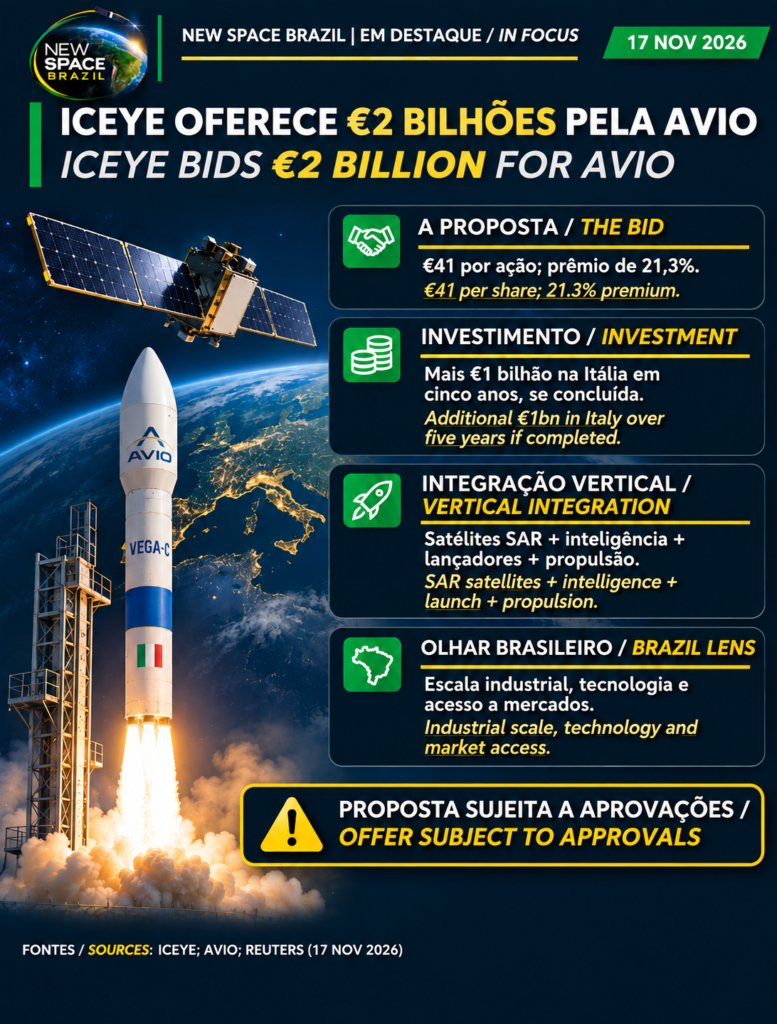
ICEYE has offered €41 per Avio share in cash, representing a premium of approximately 21.3% over Avio’s closing share price on 16 November.
The offer, valued at approximately €2 billion, would be conducted through ICEYE’s Italian subsidiary Iris 2, with the intention of delisting Avio from the Milan stock exchange.
Avio’s board has announced that it will evaluate the proposal.
ICEYE has also outlined plans to invest an additional €1 billion in Italy over five years following completion of the acquisition.
The investment would support manufacturing capacity, research and development, launch operations and the expansion of services for commercial and institutional customers.
ICEYE says it intends to preserve Avio’s Italian industrial identity, brand and workforce while honouring existing customer commitments.
However, the transaction remains subject to shareholder acceptance and regulatory approvals, including Italian government scrutiny of strategic industrial assets.
It is therefore important to distinguish the announcement of a takeover offer from a completed acquisition.
Why Avio matters
Avio is an important participant in Europe’s space launch and propulsion industry.
The company develops and manufactures the Vega-C launch vehicle, designed primarily to deliver satellites to low Earth orbit.
It also contributes propulsion technologies to other European space and defence programmes.
Through Europropulsion, its joint venture with ArianeGroup, Avio participates in manufacturing the P120C solid rocket motor used by Vega-C and Ariane 6.
These activities make Avio strategically significant beyond its commercial launch business.
Its industrial capabilities are connected to European access to space, defence supply chains and long-term institutional programmes.
ICEYE’s contribution
ICEYE operates a constellation of synthetic aperture radar satellites and supplies geospatial intelligence services.
Unlike conventional optical imaging systems, SAR satellites can observe the Earth’s surface at night and through cloud cover.
These capabilities support environmental monitoring, disaster response, maritime surveillance, national security and defence applications.
ICEYE combines satellite manufacturing, constellation operations and the commercial delivery of intelligence products.
Acquiring Avio would potentially add launch and propulsion capabilities to that existing portfolio.
The resulting business could therefore participate in a wider range of activities, from building and launching satellites to operating them and delivering information to customers.
The opportunities and challenges of vertical integration
Vertical integration involves bringing multiple stages of an industrial value chain under common ownership.
In the space sector, this can include spacecraft manufacturing, launch services, constellation operations and downstream applications.
Potential advantages include greater control over launch availability, closer coordination of investment decisions and improved visibility over long-term demand.
For ICEYE, ownership of launch capabilities could reduce certain supply risks associated with constellation expansion.
For Avio, integration with an established satellite operator could provide a more predictable source of future launch demand.
However, the benefits are not guaranteed.
Combining companies with different industrial activities introduces financial, organisational and regulatory challenges.
It may also raise questions among existing customers who rely on Avio as an independent supplier.
Any combined group would need to maintain confidence that its launch and propulsion services remain accessible and competitive.
European strategic autonomy
The acquisition proposal also reflects Europe’s growing focus on strategic autonomy in space and defence.
Independent access to orbit, Earth observation, intelligence capabilities and propulsion technologies are increasingly important to national and regional security.
An ICEYE–Avio combination could potentially strengthen Europe’s industrial capacity across several of these areas.
At the same time, the transaction would involve sensitive industrial interests and existing commitments to European and US customers.
Regulatory authorities will therefore have an important role in determining whether the proposal can proceed.
What does this mean for Brazil?
ICEYE’s proposed acquisition of Avio has a direct connection with Brazil’s space programme, extending beyond the broader discussion of European industrial consolidation.
Brazil was ICEYE’s first government customer for a sovereign satellite radar capability.
In December 2020, the Brazilian Air Force contracted the Finnish company to supply the Lessonia-1 system, including two synthetic aperture radar (SAR) satellites, associated ground infrastructure and operational training.
The Carcará I and Carcará II satellites were launched in May 2022, providing Brazil with space-based radar observation capabilities supporting both civilian and military applications.
SAR technology is particularly relevant to Brazil because it enables Earth observation regardless of daylight and through cloud cover — an important advantage for monitoring the Amazon region.
According to Brazil’s Ministry of Defence, the system has supported border surveillance, illegal-mining monitoring, wildfire and disaster assessment, mapping and maritime applications.
The relationship also includes technical training and shared satellite operations. In 2024, replacement satellites were launched, as documented in Brazilian Air Force reports.
A possible new industrial dimension
In September 2026, defence publication Janes reported that ICEYE was considering establishing a satellite assembly, integration and testing facility in Brazil, potentially following the model of its Portuguese operations.
This remains a possibility under consideration, not a confirmed investment commitment.
The prospect makes the ICEYE–Avio proposal particularly relevant to Brazil’s aerospace industry.
If completed, the acquisition could combine Earth observation, geospatial intelligence, satellite manufacturing, propulsion and launch capabilities within a single industrial group.
For Brazil, this raises important questions. Could the consolidation create new opportunities for technology cooperation and industrial participation? Could Brazilian companies gain access to wider international supply chains? Or might vertical integration concentrate more activities within established European industrial centres?
There is not yet sufficient evidence to answer these questions.
Nevertheless, Brazil’s existing relationship with ICEYE demonstrates that the country is already an operational customer of one of the companies involved.
The strategic challenge is whether that relationship could eventually support greater Brazilian technological and industrial participation, without confusing future possibilities with existing commitments.
New Space Brazil analysis
ICEYE’s proposed acquisition of Avio could become an important development in the organisation of Europe’s space industry.
The strategic significance extends beyond the approximately €2 billion offer.
The proposal illustrates how launch access, satellite manufacturing, constellation operations and intelligence services are becoming increasingly interconnected.
For Brazil, the transaction is also noteworthy because it involves a company that already supplies operational capabilities to the Brazilian Air Force and has expressed preliminary interest in expanding its industrial presence in the country.
The transaction is not yet complete, and its outcome remains uncertain.
Nevertheless, it highlights a broader trend worth monitoring: competition in the space economy increasingly involves the coordination of entire industrial value chains rather than isolated products or services.
About the Companies
¹ ICEYE — Finland
Founded in 2014, ICEYE is a Finnish company specialising in the development, manufacture and operation of synthetic aperture radar (SAR) satellites.
Its technology enables Earth observation during the day or at night, including through cloud cover, supporting defence, intelligence, security, environmental monitoring and disaster management.
In addition to operating its own constellation, ICEYE supplies complete satellite systems to government customers seeking independent Earth observation capabilities.
Brazilian connection: ICEYE supplied the SAR satellites for the Brazilian Air Force’s Lessonia-1 programme, together with ground infrastructure and operational training. Brazil was its first government customer for this type of sovereign satellite solution.
Website: https://www.iceye.com
² Avio — Italy
Avio is an Italian aerospace company specialising in launch vehicles and propulsion systems for space and defence applications.
The company is responsible for the Vega launcher family, including Vega-C, which places satellites into orbit from Europe’s Spaceport in French Guiana.
Avio also contributes propulsion technologies and components to the Ariane 6 programme, including solid rocket motors developed in cooperation with ArianeGroup.
Its industrial capabilities are strategically important to Europe’s independent access to space.
Website: https://www.avio.com
Sources
- Reuters — Satellite maker ICEYE bids €2 billion for rocket maker Avio (17 November 2026)
- AeroTime — ICEYE launches takeover bid for Italy’s rocket maker Avio (17 November 2026)
- ICEYE / Iris 2 — Formal takeover offer notice (17 November 2026)
- Brazilian Ministry of Defence — 2022 Management Report
- Brazilian Air Force — 2024 Major Projects Report
- ICEYE — Complete Satellite Missions announcement
- Janes — ICEYE considers building space systems in Brazil (2026)