
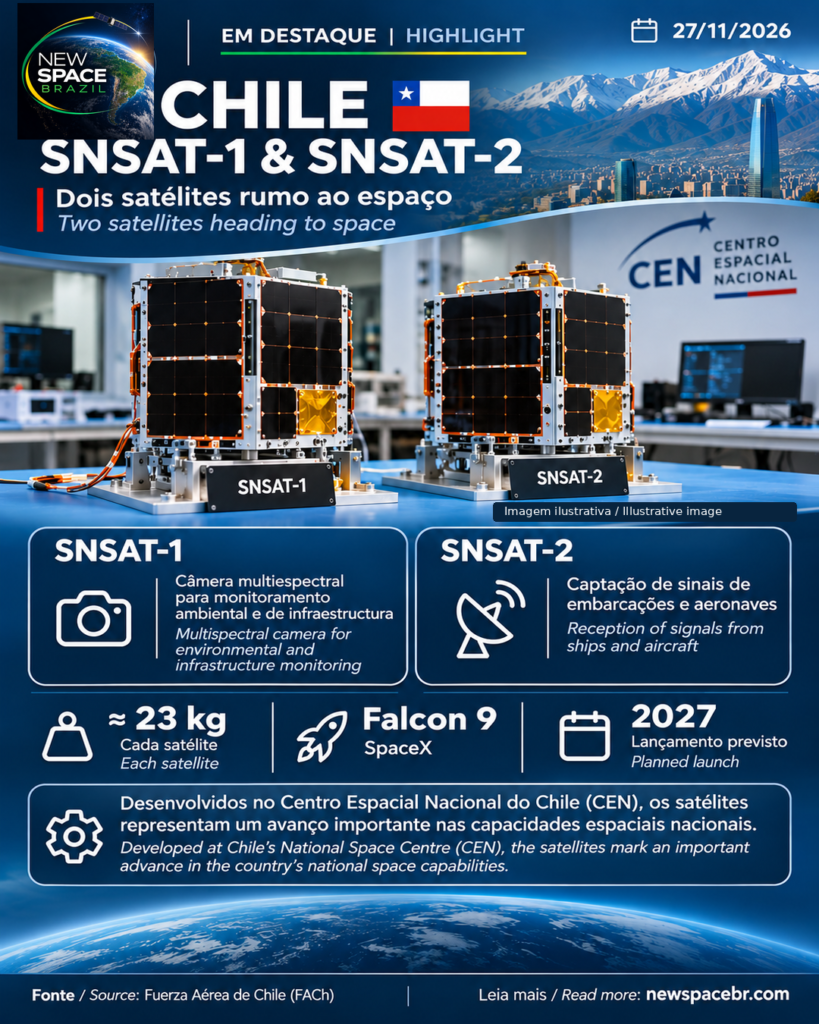
Chile advances preparations for the launch of two domestically developed satellites
The SNSAT-1 and SNSAT-2 microsatellites, developed at Chile’s National Space Centre, are undergoing preparations for testing in the United States ahead of their launch aboard a Falcon 9 rocket.
27/11/2026 | New Space Brazil
Chile has taken another important step in developing its national space capabilities with the shipment of the SNSAT-1 and SNSAT-2 microsatellites to the United States on 19 November for a further stage of launch preparations.
The development was announced by the Chilean Air Force (FACh) on 25 November and represents a milestone in the implementation of the National Satellite System (SNSAT).
The forthcoming technical assessments will verify the satellites’ operational readiness and compatibility with SpaceX’s Falcon 9 launch vehicle ahead of final integration.
The launch is planned for 2027.
Two satellites with complementary capabilities
Weighing approximately 23 kg each, the two microsatellites form part of an experimental constellation designed to expand Chile’s observation and monitoring capabilities.
SNSAT-1 is equipped with a medium-resolution multispectral camera intended for environmental and infrastructure monitoring.
SNSAT-2 is capable of receiving signals transmitted by ships and aircraft.
The complementary use of the two platforms will enable the testing of new operational concepts, combining target location information with imagery for identification and analysis.
Developing national expertise
One of the most significant aspects of the project is the direct involvement of Chilean professionals in the development, assembly and integration of the satellites.
These activities were carried out at the National Space Centre (CEN), involving both military and civilian specialists.
The completion of assembly and integration was announced on 29 October, marking an important stage in the acquisition of technical expertise and the implementation of processes that could be applied to future missions.
The Chilean programme also envisages the incorporation of ECHO-1, a satellite weighing approximately 200 kg, commissioned from a foreign company.
Significance for the Latin American space sector
Developing national space capabilities does not depend exclusively on satellite manufacturing or access to launch vehicles.
Training specialists, mastering integration processes, qualifying systems and transforming space-derived data into practical applications are equally important in building a sustainable space ecosystem.
Chile’s experience illustrates a gradual development strategy that combines international cooperation with the expansion of domestic technological capabilities.
This milestone comes ahead of the Americas Space Forum 2026, which will take place in Santiago on 30 November, providing a timely opportunity to discuss regional space cooperation.
New Space Brazil will continue to follow the evolution of Chile’s space programme and opportunities for technological and industrial cooperation across Latin America.
Sources and references
- Chilean Air Force (FACh) — 25 November 2026. SNSAT-1 and SNSAT-2 satellites to begin a key phase of testing ahead of their launch aboard a Falcon 9 rocket.
- Chilean Air Force (FACh) — 29 October 2026. Completion of the assembly and integration of the first SNSAT microsatellites in Chile.
- Chilean Air Force (FACh) — 25 August 2026. National Space Centre advances construction of two new Chilean satellites.
- Infoespacial — 27 November 2026. Chile’s SNSAT-1 and SNSAT-2 satellites arrive in the United States for integration testing ahead of their launch aboard SpaceX’s Falcon 9.