
Brazil Reshapes Its Strategic Satellite Policy: What Opportunities for Domestic Industry?
17 November 2026 | New Space Brazil
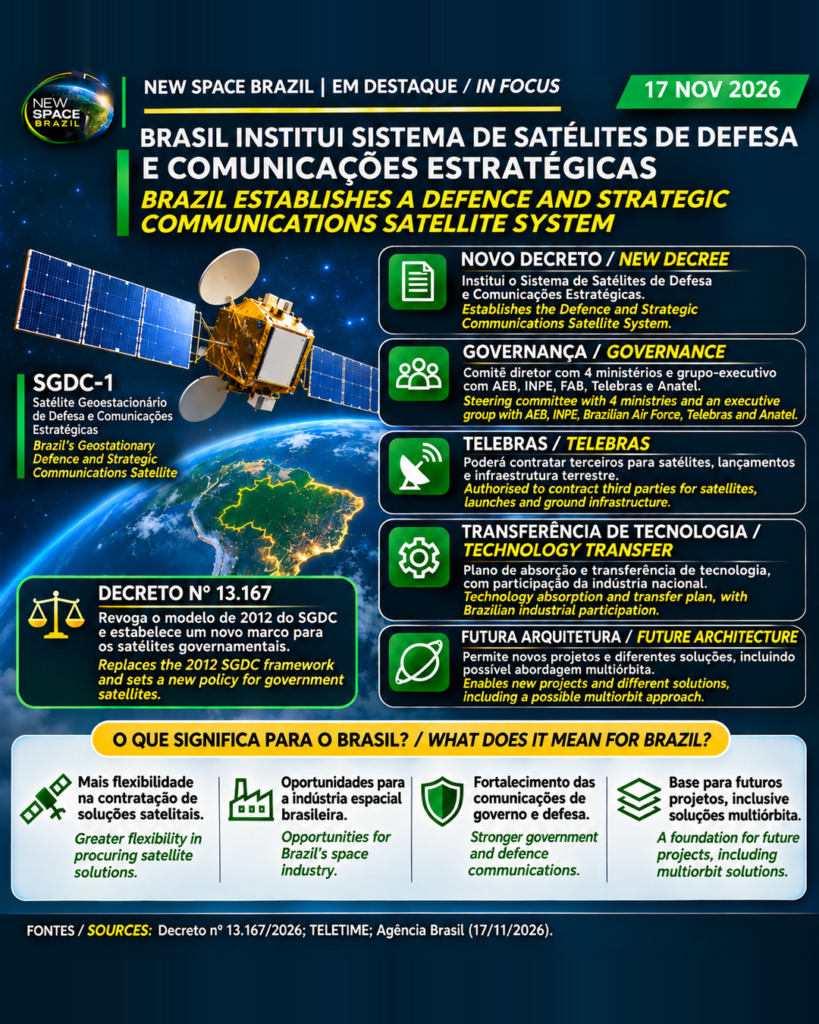
Brazil’s federal government has established a new Defence and Strategic Communications Satellite System under Decree No. 13,167, published on 17 November 2026.
The decree replaces the regulatory framework created in 2012 for Brazil’s Geostationary Defence and Strategic Communications Satellite (SGDC) programme, introducing a broader governance structure for existing and future government communications satellites.
The new framework could support more flexible procurement arrangements, multiple suppliers and potentially multiorbit satellite architectures.
For Brazil’s space industry, one of the most significant provisions is the requirement to develop technology absorption and transfer plans, including guidelines for Brazilian industrial participation.
However, the decree does not itself authorise the procurement of a new satellite or guarantee additional investment.
From SGDC-1 to a broader government satellite policy
Launched in 2017, SGDC-1 was developed to support Brazil’s strategic government communications requirements, including civilian and military applications.
The programme represented an important milestone in the development of the country’s sovereign space communications infrastructure.
Nevertheless, its original institutional framework was centred on a single government-owned geostationary satellite.
Decree No. 13,167 formally incorporates SGDC-1 into the new Defence and Strategic Communications Satellite System and revokes Decree No. 7,769/2012, which established the original programme.
The new framework covers the entire lifecycle of future government communications satellites, from mission definition, technical specifications and planning to manufacturing, integration, launch, operation and eventual disposal.
It also addresses the development and adaptation of supporting ground infrastructure.
The system is therefore an institutional and operational framework, rather than a specific new spacecraft or constellation.
A governance structure involving four ministries
The decree requires a joint ministerial act to establish two governance bodies.
A steering committee will provide strategic direction, bringing together representatives of the Ministries of Communications; Defence; Science, Technology and Innovation; and Development, Industry, Trade and Services.
The Ministry of Communications will chair the committee.
An executive group will provide technical and advisory support, including representatives of the four ministries, the Air Force General Staff, the Air Force Space Activities Command, the National Institute for Space Research (INPE), the Brazilian Space Agency (AEB), Telebras and the national telecommunications regulator, Anatel.
The arrangement is intended to coordinate decisions involving telecommunications policy, national defence, space technology and industrial development.
Its effectiveness will depend on how responsibilities, decision-making procedures and interagency coordination are implemented.
Telebras and the role of external suppliers
The decree authorises Telebras to contract third parties for goods, services and engineering works associated with satellite manufacturing, integration, launch, signal transmission and ground infrastructure.
Such procurement must follow the steering committee’s approved guidelines and applicable legislation.
Dual-use satellites serving civilian and military requirements will be operated by Telebras and the Ministry of Defence, through the Brazilian Air Force, within their respective responsibilities.
This arrangement may support more flexible supplier participation in future projects.
According to Brazilian telecommunications publication TELETIME, Telebras is already conducting market consultations concerning a possible second satellite and multiorbit integration solutions.
These activities remain preliminary and should not be confused with a final procurement decision.
Multiorbit systems: a strategic possibility
One important question is whether Brazil will move towards an architecture combining different orbital systems.
Geostationary satellites provide continuous coverage of large geographical regions and remain well suited to many government communications applications.
Low Earth orbit systems can offer lower latency and complementary coverage or capacity, although they involve different operational and network requirements.
A multiorbit architecture could combine these characteristics, potentially improving flexibility and resilience.
However, Decree No. 13,167 does not mandate the procurement of a low Earth orbit constellation or specify the architecture of a future SGDC-2.
Such decisions would require technical assessments, operational requirements, funding and procurement processes.
Another unresolved issue concerns satellite services purchased independently by government agencies, including commercial low Earth orbit solutions.
The decree does not explicitly address how those arrangements would relate to the new system.
Technology transfer: a central issue for Brazilian industry
Article 6 is particularly relevant to Brazil’s domestic space industry.
It requires AEB, the Brazilian Air Force, INPE and Telebras to participate in preparing a technology absorption and transfer plan for projects covered by the decree.
The plan must address coordination, monitoring and evaluation, intellectual property rights and guidelines for the participation of Brazilian public and private organisations.
Its stated purpose includes mobilising national industry.
This creates an important opportunity to link future government satellite procurement to the development of domestic technological capabilities.
However, meaningful technology transfer requires more than technical documentation or operator training.
Sustainable industrial benefits generally depend on practical engineering capabilities, systems integration experience, component development, process knowledge and meaningful participation by local suppliers.
Mechanisms will also be needed to assess whether transferred knowledge has been absorbed and can be applied in subsequent projects.
The challenge will be translating a formal planning requirement into measurable technological and industrial outcomes.
Potential opportunities for Brazil’s space sector
Depending on the characteristics of future projects, the framework could create opportunities across several segments of Brazil’s space and telecommunications industries.
Potential areas include systems engineering and integration, ground infrastructure, antennas and terminals, mission operations software, communications security, electronics and specialised technical services.
Brazilian research institutions and private companies could also participate in development, testing and technology qualification activities.
The scale of these opportunities will depend on decisions that have yet to be made, including budgets, technical requirements, procurement structures, technology transfer obligations and industrial participation criteria.
Policy provisions supporting domestic industry do not automatically translate into contracts or investment.
New Space Brazil analysis
Decree No. 13,167 represents an important institutional development in Brazil’s strategic satellite communications policy.
By replacing a framework centred on SGDC-1 with a broader system, the government is creating the conditions for more coordinated planning of future defence and government communications capabilities.
Its long-term significance, however, will depend less on the creation of new committees than on the decisions those committees ultimately make.
Three questions deserve particular attention.
First: what technical and operational architecture will Brazil adopt for its next generation of government satellite communications?
Second: how will Brazilian industry participate, particularly in activities involving higher-value technologies and engineering capabilities?
Third: what mechanisms will demonstrate that technology transfer has produced sustainable national capabilities?
Brazil already has experience operating strategic space infrastructure. The next challenge is to turn future procurement into more substantial opportunities for domestic industrial development.
The decree establishes the institutional foundations. Its practical impact will depend on the projects, contracts and investments that follow.