Argentina: the 2027 space budget and the challenge of preserving technological capabilities
The 2026 budget reversal, technological priorities and the challenge of retaining expertise put the future of Argentina’s space programme into perspective.
New Space Brazil | Special analysis | 26 November 2026
UPDATE | 27 November 2026 – Argentina’s Chamber of Deputies approved the proposed 2027 national budget on 27 November. We have not yet established whether any of the approved amendments affect CONAE’s budget allocation. The bill now proceeds to the Senate, where consideration is expected during the extraordinary parliamentary sessions in December. This analysis was based on the proposed budget, whose figures remain subject to review and final legislative approval.
Executive summary
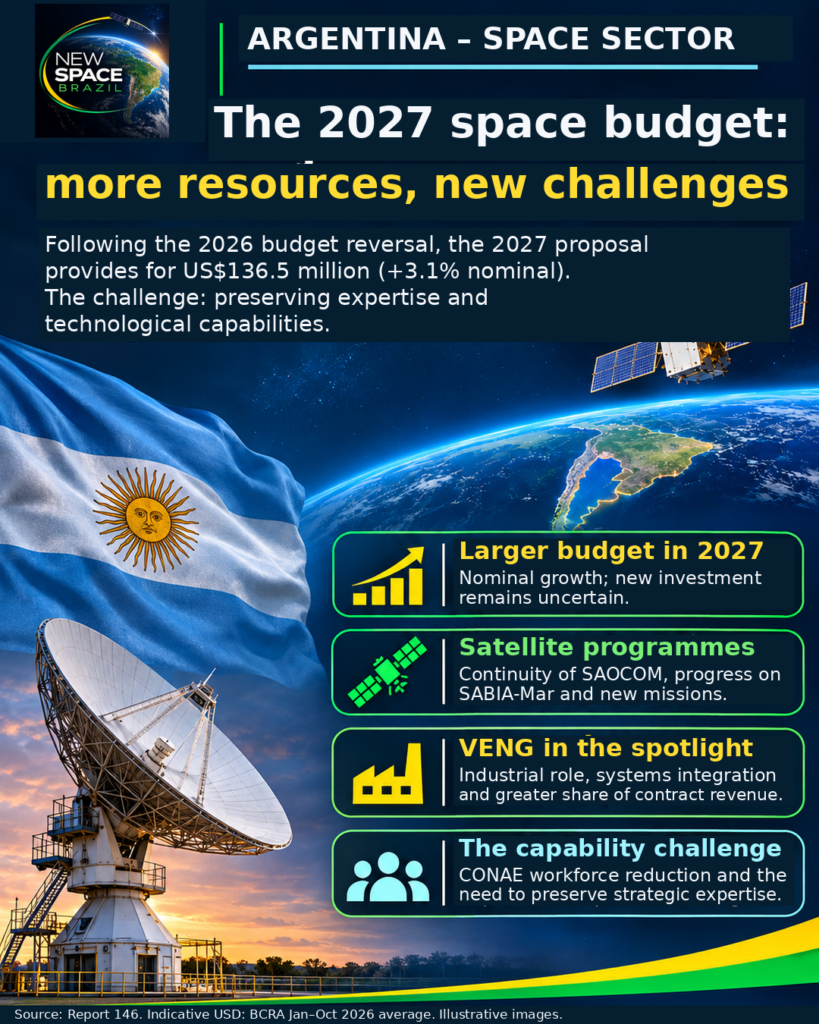
The proposed 2027 budget for Argentina’s National Commission for Space Activities (Comisión Nacional de Actividades Espaciales, CONAE), equivalent to approximately US$136.5 million, offers Argentina an opportunity to rebuild space investment. But nominal growth of just 3.1% against the government’s 2026 reference figure does not tell the whole story.
Between 2023 and 2025, CONAE expenditure fell by 19.9% in inflation-adjusted pesos and 13.3% in nominal US dollars. In September 2026, an extraordinary budget increase reversed the trend of fiscal restraint, prioritising satellites and space information infrastructure against a backdrop of growing attention to national security and the South Atlantic.
The late authorisation of funding makes it plausible that some activities will be rescheduled for 2027. Meanwhile, declining staff numbers at CONAE and the projected reduction in technical positions at VENG, a space engineering company controlled by CONAE, highlight a challenge that cannot be resolved through funding alone.
For Brazil, these developments merit attention both for the opportunities for cooperation in Earth observation and for the potential integration of the region’s space industry supply chains.
1. The 2027 budget in perspective
Over several decades, Argentina has developed capabilities in satellite engineering, Earth observation, telecommunications and launch vehicle development. The central question for 2027 is to what extent the proposed funding will enable these capabilities to be preserved and expanded.
Report No. 146 from the Chief of the Cabinet of Ministers, submitted to the Senate on 24 November 2026, projects a CONAE budget of 198.113 billion Argentine pesos (US$136.5 million). Compared with the revised allocation of 192.207 billion pesos stated in the same document, this represents nominal growth of 3.07%.
However, on 23 November the official Presupuesto Abierto (Open Budget) portal recorded a current allocation of 194.494 billion pesos (US$134 million). If directly comparable with the 2027 projection, the increase would be just 1.86%. The reasons for the discrepancy between the sources have not yet been established. In either case, inflation may exceed nominal growth and erode domestic purchasing power.
To understand the scale of this challenge, New Space Brazil also examined budget execution from 2023 to 2025. Accrued expenditure fell from US$64.9 million in 2023 to US$55.9 million in 2024, recovering slightly to US$56.3 million in 2025. In constant 2025 pesos, the cumulative decline was 19.9%, compared with 13.3% in nominal dollars
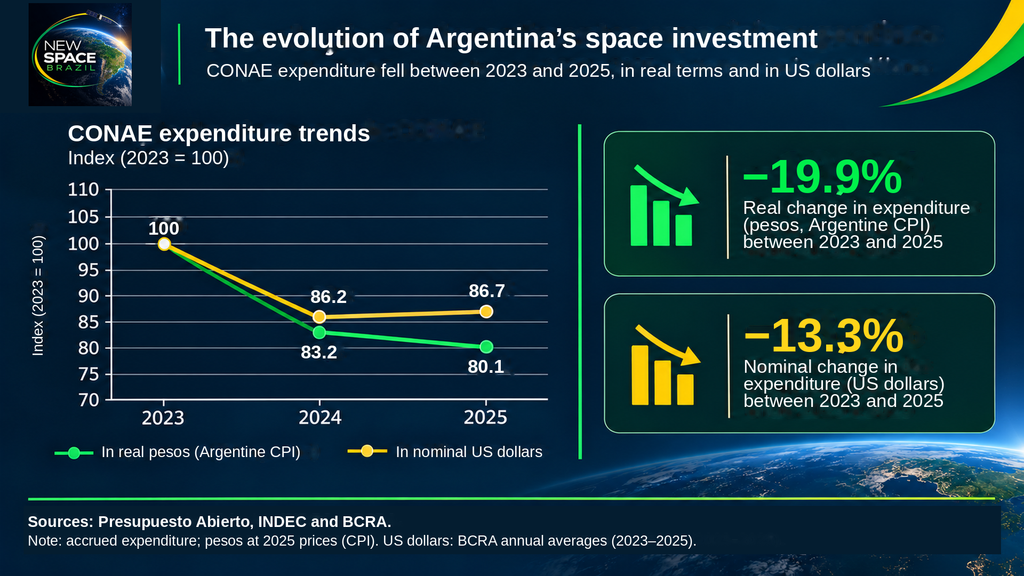
The two perspectives are complementary. Argentina’s consumer price index (CPI) is relevant to domestic expenditure, but does not necessarily reflect the cost of imported components, specialised equipment or internationally procured launch services. Conversion into dollars provides an additional reference point without constituting an exact measure of international purchasing power.
The composition of expenditure also changed. Between 2023 and 2025, spending on capital goods fell by approximately 45% in dollar terms, while expenditure on non-personnel services increased by 31%. The share of these services rose from 37.5% to 56.7% of expenditure. Specialist contracts can contribute to technological development, but this shift merits attention when assessing the capacity to invest in in-house infrastructure and equipment.
2. The 2026 budget reversal
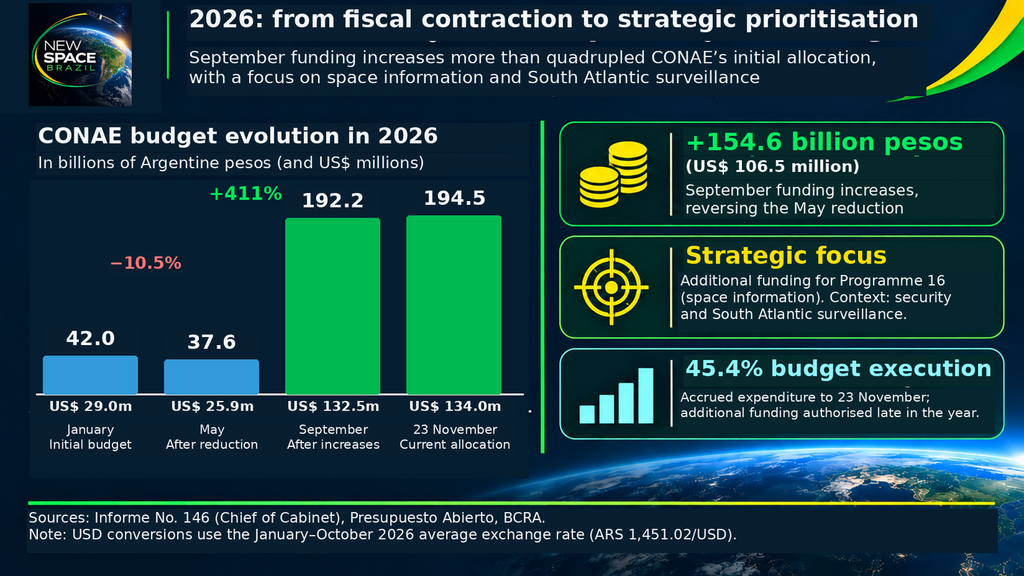
The original 2026 budget was 42.014 billion pesos (US$29 million). In May, a reduction of 4.410 billion pesos further diminished available resources. The trajectory changed radically in September, with two supplementary allocations associated with Decree No. 867/2026 and Administrative Decision No. 26/2026, totalling 154.6 billion pesos (US$106.5 million).
The revised allocation reached 192.2 billion pesos, an increase of approximately 411% against the reduced May baseline. By November, Presupuesto Abierto recorded US$134 million, more than four times the original budget.
A shift in strategic priorities
Both September supplementary allocations were entirely directed to Programme 16 (generation of space-derived information, including satellite missions and ground infrastructure), with no corresponding increase for Programme 17 (research and development of independent means of access to space, including launch vehicles).
The Argentine press placed Decree No. 867/2026, which also increased funding for defence and intelligence, in the context of government measures concerning the South Atlantic and the Sea Lion oil project in the vicinity of the Falkland Islands (Malvinas), administered by the United Kingdom and claimed by Argentina.
The sequence of events suggests that national security considerations contributed to the prioritisation of observation and space information capabilities. This does not mean that all additional funding is intended for military purposes: satellites and ground infrastructure also serve civilian, environmental and economic needs.
Budget execution and continuity in 2027
By 23 November, CONAE had accrued expenditure of 88.362 billion pesos (US$60.9 million), equivalent to 45.4% of its current allocation. Payments amounted to US$43.1 million. A further US$17.8 million represented accrued but unpaid expenditure, which does not necessarily mean that payments were overdue.
The execution rate must be interpreted in light of when funding was authorised. Accrued expenditure already represented approximately 210% of the original budget, while the September supplementary allocations accounted for almost 80% of the current November allocation. Absorbing funding on this scale in less than four months requires time for technical specifications, supplier selection, contract negotiations and specialist procurement.
With just over five weeks remaining in the financial year, 54.6% of the allocation had yet to be executed on an accrual basis. It is therefore plausible that part of the 2027 budget will finance activities originally planned for 2026, particularly in multi-year projects such as SABIA-Mar, SARE II A and ground infrastructure.
This interpretation does not imply an automatic carry-over of unspent appropriations into the following financial year. Nor does it allow us to quantify how much of the 2027 proposal relates to rescheduled expenditure. This will require information on the 2026 year-end position and the projects’ contractual commitments.
Projected growth in 2027 should therefore be viewed not only as a possible expansion of investment, but also as an opportunity to continue activities that could not be fully implemented in 2026.
3. Satellites versus independent access to space
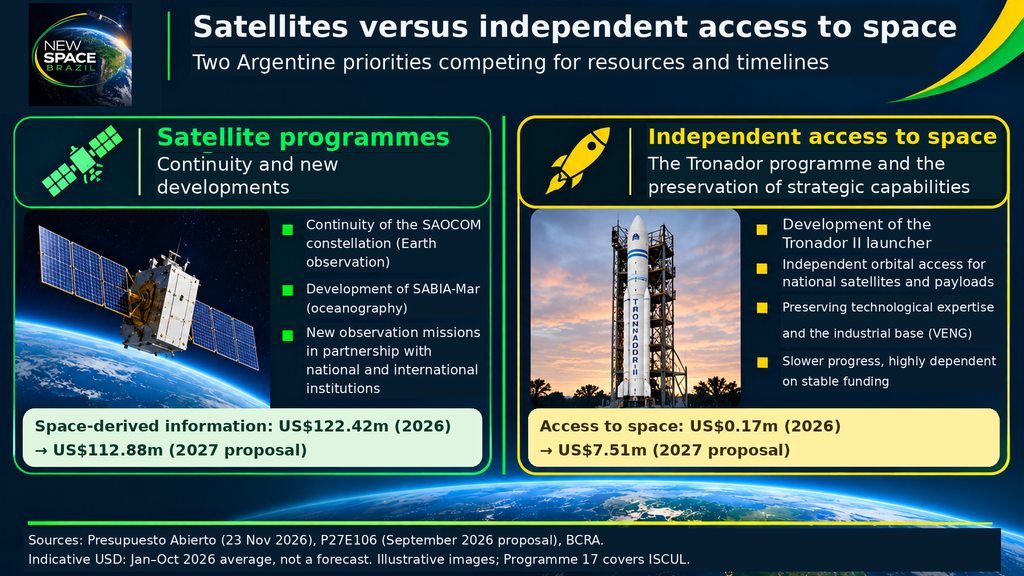
The distribution of resources reveals a shift in priorities that predates the September supplementary allocations. Between 2023 and 2025, CPI-adjusted expenditure increased by approximately 13% in the space information programme, while falling by around 70% in the access-to-space programme.
In November 2026, space information accounted for 91.3% of CONAE’s current allocation, compared with just 0.13% for the development of means of access to space.
The detailed September proposal for 2027, totalling 194.169 billion pesos (US$133.8 million), provides for US$112.9 million for space information and US$7.5 million for access to space. Approximately 75.6% of the overall budget in this proposal is classified as capital expenditure. The detailed breakdown relates to the September proposal, not the overall November projection.
Satellite missions: a focus on SABIA-Mar
Among Earth observation projects, SABIA-Mar, designed to monitor oceans and coastal regions, is particularly relevant to Brazil because of space cooperation between the two countries. Its Argentine allocation increased from US$8.7 million in the original 2026 budget to US$37.4 million in November, nominal growth of approximately 327%. By 23 November, US$26 million had been accrued as expenditure.
The 2027 proposal provides for continued integration, testing and certification, alongside activities relating to the ground segment and launch services.
Other projects show different levels of execution. Construction of the four SARE II A satellites had an execution rate of just 7.8% against an allocation of US$8.2 million. The specific budget line for construction of the SAOCOM 2 A/B satellites, the second generation of Argentina’s synthetic aperture radar (SAR) observation mission, was sharply reduced in 2026, with no accrued expenditure by the date examined. This does not establish that the project has been suspended, as other budget lines may finance related activities. Both projects remain included in the 2027 proposal.
Tronador: recovery or limited continuity?
The ISCUL programme (Inyector Satelital para Cargas Útiles Livianas, or satellite launcher for light payloads) seeks to develop a national orbital launch capability. The 2027 proposal reaffirms objectives for the Tronador II and III family, including payloads of 500 to 750 kg in polar orbits of approximately 600 km.
However, in 2026 the specific allocation for construction of the Tronador II A, B and C vehicles was reduced by 80.4%, from US$876,000 to US$172,000. Although execution reached 96.8%, accrued expenditure amounted to just US$166,000. A high execution rate does not necessarily indicate an adequate level of investment.
The US$7.5 million proposed for the broader access-to-space programme in 2027, including US$5.4 million for machinery and equipment, signals a possible recovery from an exceptionally low baseline. It does not, however, confirm a resumption of full launch vehicle development or establish dates for flight tests.
VENG’s 2026 action plan describes its role as prime contractor for the Tronador II prototype up to 2025 and emphasises commercial opportunities in technologies derived from ISCUL. At the same time, it retains activities involving critical technology development and propulsion testing. The document suggests a shift in priorities, not a formal cancellation of the programme.
4. The challenge of preserving human and industrial capabilities
The ability to implement space projects depends on professionals whose training and experience may take many years to acquire. Report No. 146 records a reduction in CONAE’s permanent and contracted workforce from 279 people in 2023 to 227 in 2026, equivalent to 18.6%. Between 2024 and 2026, 38 departures from the permanent workforce were recorded, with no new recruits in that category between 2023 and 2026.
The data do not establish how many of those who left were technical specialists, nor do they allow all departures to be attributed to redundancies. Nevertheless, the reduction merits attention in an institution responsible for long-term technological programmes.
The government identifies the budget increase and the update of the National Space Plan as instruments for retaining human capital. The 2027 proposal provides for 269 authorised posts, compared with 267 in the original 2026 budget. Authorisation, however, does not guarantee that vacancies will be filled.
VENG: commercial diversification and retention of expertise
VENG operates in engineering, launch vehicle development, manufacturing, satellite integration and testing, and the operation of space infrastructure. Its 2026 action plan and budget, approved by Ministry of Economy Resolution No. 1534/2026, provide an industrial perspective complementary to the analysis of CONAE. The annexes were prepared in August, before the September supplementary allocations.
Projected staffing falls from 360 to 330 people between the first half and the end of 2026. The entire projected reduction is concentrated in technical and professional positions, from 317 to 287 (−9.5%), while administrative staffing remains unchanged. This is a projection, not confirmed departures, and should not be added directly to the observed reduction at CONAE.
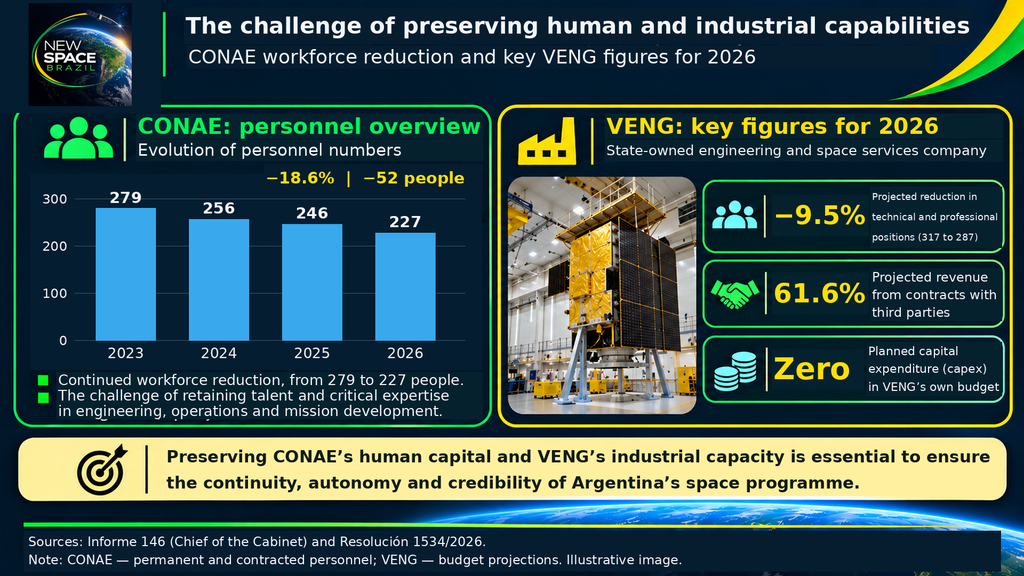
The company’s commercial strategy presents opportunities. Of its projected operating revenue of US$14.85 million, 61.6% comes from contracts with third parties and 38.4% from contracts with CONAE. The third-party category does not distinguish between public, private or international customers. The plan includes specialist services in propulsion, avionics, advanced manufacturing and space operations, identifying services already provided to Brazil’s Visiona Tecnologia Espacial as a reference for international expansion.
On the other hand, the budget projects an operating margin of just 0.63% and no capital expenditure of its own. This does not exclude investments made directly by CONAE in facilities used by VENG, but highlights the limits of the company’s planned investment from its own budget.
Commercial diversification may help retain expertise and reduce dependence on a single customer. Its success, however, does not necessarily equate to restoring the industrial capabilities required to develop a complete launch vehicle. Continuity of strategic projects, retention of specialists and availability of infrastructure remain essential.
5. Prospects for 2027 and opportunities for Brazil
Updating the National Space Plan offers Argentina an opportunity to define long-term technological and industrial priorities. In addition to satellite missions and launch technologies, the 2027 proposal encompasses artificial intelligence applications in data processing, international cooperation and development of the Argentine Space Hub (Hub Espacial Argentino), with greater private-sector participation.
It is important to remember that CONAE does not represent the entirety of Argentina’s space economy. Projects such as the ARSAT-SG1 geostationary telecommunications satellite, developed by INVAP, have their own institutional and financial structures. A comprehensive assessment of the sector must also consider these activities and the commercial initiatives of emerging companies.
For Brazil, SABIA-Mar and the services provided by VENG to Visiona illustrate two complementary dimensions of cooperation: intergovernmental programmes and industrial relationships. The former may increase the availability of information on oceans and coastal regions; the latter offers opportunities to integrate supply chains and share specialist capabilities.
There are also opportunities in environmental monitoring, agriculture, ground infrastructure and professional training. The CubeDesign competition held in Argentina in November 2026, for the first time outside Brazil since its creation by Brazil’s National Institute for Space Research (INPE), demonstrates the potential of regional integration in training new generations of specialists.
More structured cooperation could increase the scale of projects, reduce duplication of investment and strengthen the Latin American space industry. This requires clear technological objectives, institutional commitments and funding mechanisms that ensure continuity.
6. Conclusion
The September 2026 budget increase represents an important opportunity for Argentina’s space programme, but does not eliminate the effects of declining investment in previous years or, in itself, guarantee the recovery of technological capabilities.
In 2027, it will be particularly important to monitor budget execution, any rescheduling of activities, the timetable for satellite missions and the definition of a concrete way forward for the Tronador programme. The update of the National Space Plan should also be assessed on its ability to translate intentions to retain and train professionals into effective measures.
For Argentina, as for Brazil, the challenge is to reconcile national strategic priorities with a sustainable industrial base and opportunities for regional cooperation. The principal measure of success will not simply be nominal budget growth, but the ability to translate resources into technological outcomes and retain the expertise required for future projects.
Building technological capabilities can take decades. Preserving them requires consistent investment, strong institutions and a vision that extends beyond annual budget cycles.
Sources and methodology
Dollar figures are indicative and use the official monthly average exchange rates of Argentina’s central bank (BCRA), aggregated using the arithmetic mean: 296.5169 ARS/USD in 2023; 916.3185 in 2024; 1,243.7875 in 2025; and 1,451.0166 between January and October 2026. The latter rate is also used for 2027 solely for comparison and does not constitute an exchange-rate forecast. Exchange-rate fluctuations may affect comparability. Dollar figures are nominal. The national CPI adjustment uses annual averages, with 2025 as the base year; it does not represent a space-sector cost index.
Budget execution refers to devengado (accrued expenditure recognised in the accounts), distinct from payments. The 2026 data are as at 23 November, not the financial year-end. The 2027 figures are proposals or projections. Differences between official documents are reported separately.
Argentine Senate — Report No. 146, file PE-365/26, received on 24 November 2026. Responses 1250 (p. 378), 467 (p. 540), 810 (pp. 1034–1035) and 814 (pp. 1037–1038), PDF page numbering. View source
National Budget Office — Draft Budget 2027, Entity 106, document P27E106, pp. 4–16. View source
Presupuesto Abierto — annual budget execution 2023–2025 and data extracted on 23 November 2026 (Entity 106). View source
CONAE — budget transparency. View source
Official Gazette — Administrative Decision No. 1/2026, 20 January 2026, Annex I, pp. 156–162. View source
Congressional Budget Office — 2026 budget amendments, reports 2 and 4 (DA 20, DA 26 and DNU 867). View source
Decree No. 867/2026 — official text, 4 September 2026. View source
INDEC — national CPI, historical series. View source
BCRA — monthly average nominal exchange rate (Tipo de Cambio Nominal Promedio Mensual). View source
Ministry of Economy — Resolution No. 1534/2026, 11 September 2026, Annexes I and II (IF-2026-78472995-APN-SSP#MEC and IF-2026-78238042-APN-SSP#MEC). View source
Argentine Presidency — Official Communication No. 157, 3 September 2026. View source
TN — coverage of supplementary funding for defence, SIDE and CONAE, 4 September 2026. View source
TN — South Atlantic surveillance plan, 5 September 2026. View source
UNSAM — CubeDesign 2026, About the Event. View source
New Space Brazil — calculations and analysis of official documents.