
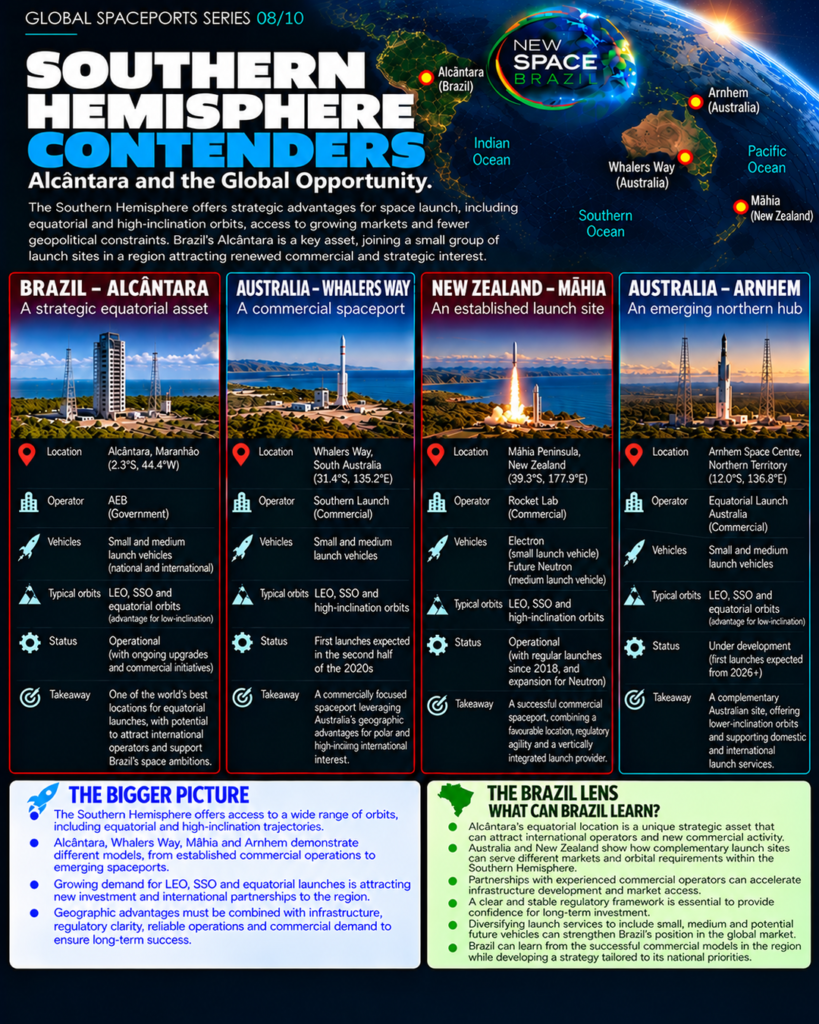
Global Spaceports Series | Chapter 08/10 — Southern hemisphere contenders
Following our examination of the emerging North Atlantic commercial spaceport network, New Space Brazil continues its 10-part Global Spaceports Series, exploring how geography, infrastructure, and commercial strategies shape access to orbit.
🌎 ALCÂNTARA AND THE GLOBAL OPPORTUNITY
The Southern Hemisphere offers a diverse range of launch opportunities, from near-equatorial trajectories to polar and sun-synchronous orbits.
Brazil, Australia, and New Zealand illustrate different approaches to developing launch infrastructure, combining geographical advantages, national strategic interests, and commercial ambitions.
Four locations highlight these opportunities:
📍 Brazil — Alcântara Launch Centre: Located just 2.3° south of the equator, Alcântara offers favourable conditions for low-inclination and equatorial missions. Its strategic potential is significant, but developing sustained commercial orbital launch operations remains a challenge.
📍 Australia — Whalers Way Orbital Launch Complex: Developed by Southern Launch in South Australia, Whalers Way is positioned to support launches towards polar and sun-synchronous orbits. It illustrates how launch infrastructure can be designed around specific orbital requirements and commercial customers.
📍 New Zealand — Māhia Peninsula: Home to Rocket Lab’s established orbital launch operations, Māhia demonstrates how a privately operated launch site can become internationally competitive through regulatory support, reliable infrastructure, and an integrated launch service.
📍 Australia — Arnhem Space Centre: Developed by Equatorial Launch Australia in the Northern Territory, Arnhem offers access to lower-inclination trajectories and has already supported suborbital research launches. Its geographical role complements Australia’s southern launch facilities.
🌐 THE BIGGER PICTURE
The Southern Hemisphere is not a single launch market — its geography supports distinct orbital requirements and commercial opportunities.
Australia’s northern and southern facilities demonstrate the potential value of complementary launch locations serving different orbital inclinations.
New Zealand illustrates how a commercial launch operator can develop a competitive international service from a relatively remote location.
Together, these examples reinforce a fundamental principle: geographical advantages create opportunities, but commercial success depends on reliable operations, infrastructure, regulatory clarity, and sustained customer demand.
🇧🇷 THE BRAZIL LENS — WHAT CAN BRAZIL LEARN?
Alcântara’s near-equatorial location is a strategic advantage, but it does not necessarily address every orbital requirement.
Australia’s approach raises an important question for Brazil: should the country evaluate complementary launch locations better suited to polar and high-inclination missions?
New Zealand offers another lesson: a commercially successful spaceport requires more than favourable geography. It depends on dependable infrastructure, a supportive regulatory environment, operational efficiency, and customers.
For Brazil, the strategic priority should be to develop a national launch capability aligned with market demand, rather than treating the development of a single launch centre as an end in itself.
This could involve strengthening Alcântara’s commercial proposition while evaluating whether additional launch infrastructure, alternative launch methods, or international partnerships would provide greater long-term value.
📅 NEXT IN THE SERIES
Post 09 — Sovereign Hubs in Transition
Monday, 23 November 2026
How Baikonur and Vostochny illustrate the challenges of adapting major state-backed launch infrastructure to a changing global space economy.
👉 Follow the New Space Brazil LinkedIn company page so you don’t miss the next instalment of our Global Spaceports Series.
Originally published on Linkedin.