Latin American Space Cooperation: Bariloche Brings Experts Together, but Government Commitments Remain Unclear
A meeting in Argentina brought together space industry, academic and research representatives from seven Latin American countries. Its composition raises questions about how regional dialogue can evolve into funded programmes, particularly given the existence of ALCE.
Regional cooperation takes centre stage
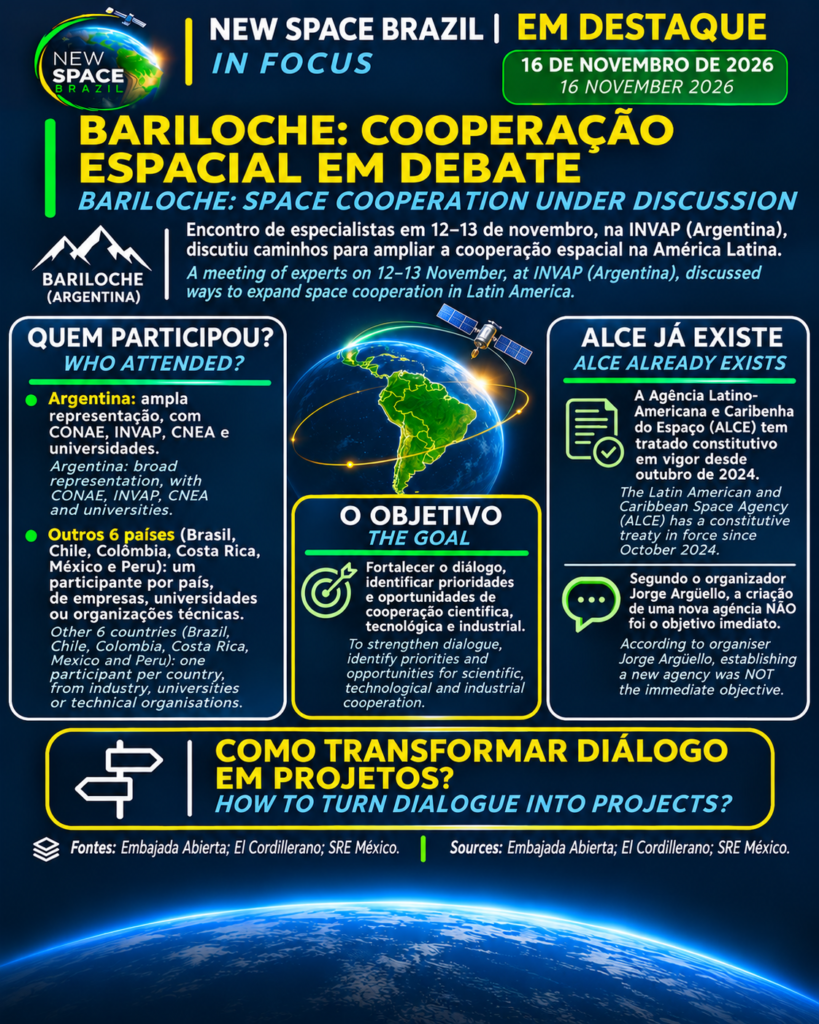
On 12–13 November 2026, INVAP hosted the Latin American Meeting on Space Development and International Cooperation in San Carlos de Bariloche, Argentina. Organised by Fundación Embajada Abierta and the Konrad Adenauer Foundation, the meeting brought together specialists from Argentina, Brazil, Chile, Colombia, Costa Rica, Mexico and Peru, alongside a representative of the European Space Agency (ESA).
Discussions explored coordination of scientific, technological and industrial capabilities. Yet the meeting highlights the distinction between experts participating and governments making formal commitments.
Who attended, and in what capacity?
Argentina had broad institutional participation, including CONAE, INVAP, CNEA, universities and research organisations. The published programme identified just one participant from each of the other six Latin American countries.
Brazil’s participant was João Paulo Rodrigues Campos, President and CEO of Visiona Tecnologia Espacial. Chile’s was Jonathan Hodge of Universidad Adolfo Ibáñez; Colombia’s María Soledad Bastidas Jaramillo, associated with military aviation education; Costa Rica’s Esteban Carrillo of the Costa Rica Aerospace Cluster; Mexico’s Gustavo Medina Tanco of UNAM; and Peru’s Tito Roberto Vilchez Vilchez of Universidad Nacional de Ingeniería.
These participants brought relevant expertise, but the programme did not identify formal government delegations from these six countries or officials authorised to negotiate national commitments. A company executive’s participation does not constitute an official government commitment.
The organisers clarify their objectives
In an interview with El Cordillerano, Jorge Argüello, President of Fundación Embajada Abierta, described the meeting as academic in nature, building on work initiated the previous year. He clarified that establishing a new Latin American space agency was not the immediate objective. The emphasis was on relationships and identifying common priorities.
This is essential context for reports suggesting the meeting was intended to establish an ESA-inspired regional agency.
ALCE: an existing regional institution
The Constitutive Agreement of the Latin American and Caribbean Space Agency (ALCE) was signed in September 2021 and entered into force internationally on 27 October 2024. Headquartered in Mexico, it provides a legal framework for regional cooperation in peaceful space applications.
Legal establishment does not imply full operational maturity or funding. Nevertheless, Bariloche documentation does not explain how new cooperation efforts would relate to ALCE. Countries represented by individual experts should not be confused with states that have formally become parties to its treaty.
What can Latin America learn from ESA?
ESA Special Adviser for Political Affairs Kai-Uwe Schrogl participated in the meeting. ESA illustrates how countries pool funding, expertise and industrial capacity for shared programmes.
But an ESA-style arrangement requires long-term commitments, governance, agreed priorities and mechanisms for industrial participation. Latin America’s varying budgets, industrial structures and political priorities create additional challenges. Expert networks can initiate cooperation; government institutions and programme sponsors are needed for substantial public funding.
Brazil’s participation and its limitations
Visiona’s involvement is relevant because industry can translate cooperation into technical projects and commercial opportunities. However, the published programme did not identify an official delegation from the Brazilian Space Agency (AEB), the Ministry of Science, Technology and Innovation or other Brazilian government bodies.
This does not mean the Brazilian government opposes the initiative; formal commitment simply cannot be inferred. Effective cooperation requires national agencies, industry, universities and research institutions to agree on priorities, funding and responsibilities.
From dialogue to joint missions
Bariloche can be viewed as an exploratory step towards complementary capabilities and professional relationships. Its significance will depend on concrete projects.
Questions include: Which national institutions coordinate follow-up? How do projects relate to ALCE and bilateral agreements? Who provides funding? Which applications offer measurable regional benefits? How are technical responsibilities and industrial opportunities allocated?
No new constitutive agreement, funded regional programme or formal implementation timetable has been identified as an outcome of the meeting.
New Space Brazil analysis
Bariloche brought knowledgeable participants together but its institutional composition indicates an exploratory initiative rather than formal intergovernmental negotiations. Expert engagement is valuable; sustained programmes require authority, financing and clear implementation.
ALCE provides an existing legal framework that should be considered. The real measure of regional cooperation will be the delivery of jointly funded, technically credible and operationally successful programmes.
Sources and references
Fundación Embajada Abierta — Participantes e objetivos
https://www.embajadaabierta.org/post/la-argentina-reunir%C3%A1-en-bariloche-a-referentes-espaciales-de-am%C3%A9rica-latina-y-europa
El Cordillerano — Entrevista com Jorge Argüello
https://www.elcordillerano.com.ar/noticias/2026/11/13/273056-cooperacion-espacial-en-bariloche-el-objetivo-del-encuentro-internacional-que-reunio-a-especialistas-de-ocho-paises-en-invap
Secretaría de Relaciones Exteriores de México — Entrada em vigor ALCE
https://www.gob.mx/sre/prensa/entra-en-vigor-convenio-constitutivo-de-la-agencia-latinoamericana-y-caribena-del-espacio?idiom=es-MX
Diario Oficial de la Federación — Convênio Constitutivo ALCE
https://sidof.segob.gob.mx/notas/docFuente/5741705
Registro de tratados internacionais — México
https://cja.sre.gob.mx/tratadosmexico/