
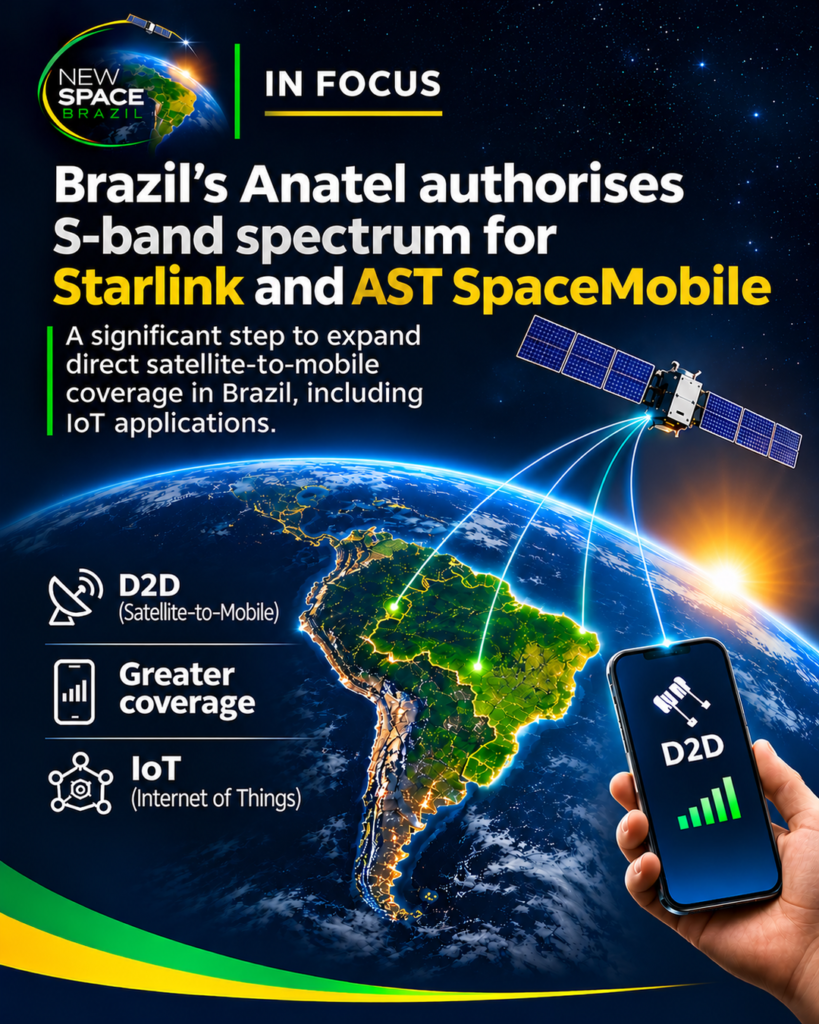
Spectrum is power: Brazil and the global battle for direct satellite-to-mobile connectivity
As new satellite constellations promise to extend mobile network coverage directly from space, access to radio spectrum is emerging as one of the principal strategic factors shaping competition in the satellite connectivity market. Recent decisions by Brazil’s telecommunications regulator, Anatel, place the country at the centre of this debate.
24 November 2026 | New Space Brazil — Analysis
Update — 26 November 2026
Anatel broadens the D2D debate: critical infrastructure and digital sovereignty
At a joint meeting of Anatel’s C-INT and CEO committees, held on 24 November, the regulator’s President, Alexandre Freire, requested further studies to assess whether direct-to-device satellite connectivity (D2D) should be classified as critical telecommunications infrastructure.
According to a report published by TELETIME on 25 November, Freire also requested a complementary study, involving the regulator’s international affairs team, to examine the geopolitical implications of satellite constellations.
The meeting also addressed updates to Brazil’s Spectrum Use Plan and preparations for the 2027 World Radiocommunication Conference (WRC-27).
Although no decision has yet been taken on classifying D2D services as critical infrastructure, these initiatives reinforce the strategic significance of the issues examined in this analysis.
The future of direct satellite-to-mobile connectivity is likely to involve not only decisions concerning spectrum access and competitive conditions, but also broader considerations relating to digital sovereignty, security and the resilience of national telecommunications infrastructure.
Our in-depth analysis of Anatel’s recent decisions, the strategic importance of radio spectrum and Brazil’s position in the global competition for direct satellite-to-mobile connectivity, originally published on 24 November 2026, follows below.
– Analysis –
The ability to connect mobile phones directly to satellites, without the need for external antennas or dedicated terminals, is transforming the relationship between the mobile telecommunications and satellite communications sectors.
Known as Direct-to-Device (D2D), this technology promises to extend connectivity to areas where the deployment of terrestrial infrastructure is economically unviable or technically challenging.
However, as different commercial initiatives progress, it is becoming increasingly apparent that the success of these operations will not depend exclusively on the technology employed, the number of satellites in orbit or the operators’ investment capacity.
Access to radio spectrum could be equally decisive.
Spectrum as a strategic asset
During Space Tech Expo Europe, held last week, representatives of the space and telecommunications industries discussed the challenges associated with spectrum availability and the development of a competitive European capability for direct connectivity between satellites and mobile devices.
In an article published by Via Satellite on 23 November, Etienne Lesoeur, Eutelsat’s Director of International Affairs, summarised the importance of this issue in three words: “Spectrum is power”.
The statement reflects a structural transformation in the satellite communications market.
Access to specific frequency bands, spectrum usage rights, international coordination arrangements and the regulatory priorities associated with satellite networks are becoming increasingly important in investment decisions, commercial partnerships, mergers and acquisitions.
A company may possess advanced technology, substantial financial resources and the capacity to launch hundreds of satellites. However, without adequate access to spectrum and the necessary authorisations in the markets where it intends to operate, its ability to offer commercially competitive services could be significantly constrained.
It is important to recognise that a network’s priority in international coordination procedures does not automatically confer the right to use spectrum in every country. National administrations continue to play a fundamental role in authorising services.
Two pathways to direct connectivity
Although frequently grouped under the D2D umbrella, direct satellite-to-mobile connectivity solutions can employ different spectrum access models.
The first uses frequencies already allocated to the Mobile-Satellite Service (MSS), incorporating satellite communications capabilities into compatible mobile devices.
The second uses frequencies traditionally designated for terrestrial mobile networks, through agreements with telecommunications operators and specific regulatory authorisations.
Under this second model, satellites act as an extension of terrestrial network coverage, allowing conventional mobile phones to be used under certain conditions without specific hardware modifications.
Both models present distinct advantages and limitations.
Whilst the first offers satellite operators greater independence from access to terrestrial mobile operators’ spectrum, the second allows them to leverage established frequencies and device ecosystems.
The evolution of Non-Terrestrial Network (NTN) technology standards developed within the 3rd Generation Partnership Project (3GPP) should contribute to greater integration between these different environments.
Technological compatibility alone, however, does not eliminate the need for frequency coordination, protection against interference and regulatory harmonisation.
Brazil: the battle for S-band spectrum is already under way
Direct satellite-to-mobile connectivity presents significant potential for Brazil.
The country’s vast territory, the geographical characteristics of the Amazon, the existence of isolated communities and limitations in rural mobile coverage create particularly relevant conditions for the use of non-terrestrial networks.
Potential applications include:
- Communications in areas without terrestrial mobile coverage;
- Emergency connectivity during natural disasters;
- Safety of workers and communities in remote areas;
- Support for agricultural, logistics and environmental activities;
- Reduction of regional inequalities in access to telecommunications.
The strategic importance of spectrum for these applications has taken on a tangible dimension in Brazil following recent decisions by the National Telecommunications Agency (Anatel) involving two of the leading companies competing in this global market: SpaceX’s Starlink and AST SpaceMobile.
Through Acts No. 14,140 and No. 14,181, published in Brazil’s Official Gazette on 17 and 19 November 2026, respectively, Anatel formalised the expansion of AST SpaceMobile’s satellite exploitation rights and granted Starlink a new satellite exploitation right involving S-band frequencies.
These decisions allow each company to use 15+15 MHz within the 1980–2010 MHz and 2170–2200 MHz frequency bands allocated to the Mobile-Satellite Service.
The acts cover systems comprising up to 248 satellites in the case of AST SpaceMobile and up to 7,500 satellites in the case of Starlink. These figures represent the limits established in the respective authorisations, rather than the number of satellites currently in operation.
Although both companies have access to the same amount of spectrum, their authorisations have different validity periods.
S-band spectrum distribution in Brazil
| Operator | Earth-to-space (MHz) | Space-to-Earth (MHz) | Bandwidth | Expiry date |
| Starlink | 1980–1990 | 2170–2180 | 10+10 MHz | 10 Feb 2038 |
| Starlink | 1990–1995 | 2180–2185 | 5+5 MHz | 5 Jun 2029 |
| AST SpaceMobile | 1995–2000 | 2185–2190 | 5+5 MHz | 5 Jun 2029 |
| AST SpaceMobile | 2000–2010 | 2190–2200 | 10+10 MHz | 3 Oct 2032 |
Sources: Anatel — Acts No. 14,140 and No. 14,181, November 2026.
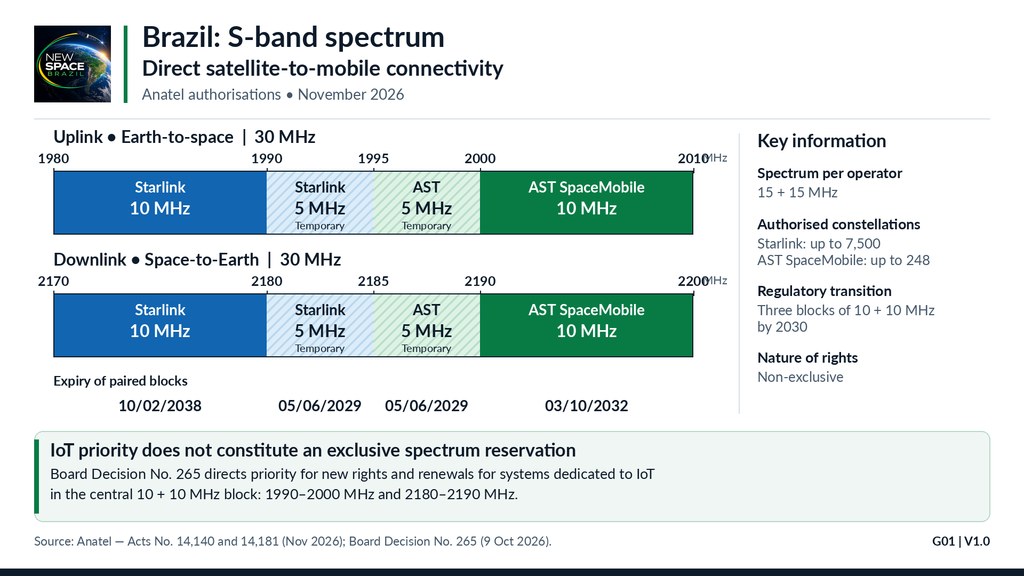
Together, the authorised sub-bands cover the entire 30+30 MHz of this frequency range — precisely the same spectrum that is at the centre of discussions concerning the future of mobile-satellite services in the European Union.
Importantly, these satellite exploitation rights are granted on a non-exclusive basis. This does not necessarily mean that sharing the same frequencies between different systems is technically straightforward, nor that these authorisations alone satisfy all the regulatory requirements for the commercial provision of D2D services.
An evolving regulatory strategy
The spectrum distribution formalised in November represents an evolution of Anatel’s original approach.
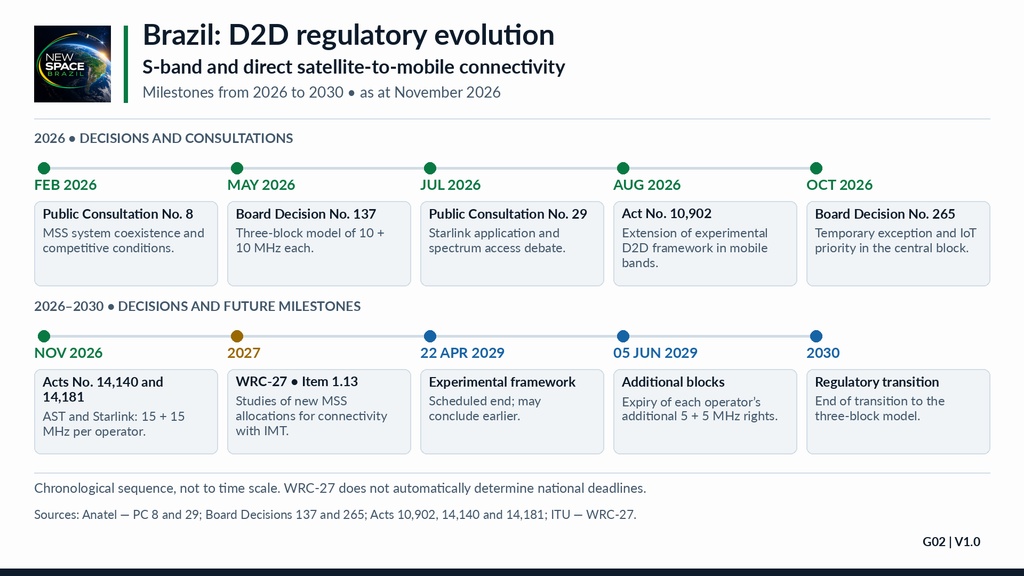
In May 2026, through Board Decision No. 137, the Agency established a division of the S-band into three blocks of 10+10 MHz, limiting authorisations to one block per satellite operator.
Starlink had initially requested the entire 30+30 MHz frequency range. However, through Board Decision No. 265 of 9 October 2026, Anatel’s Board partially approved the application, preserving the three-block model whilst introducing a temporary exception.
The decision took into account the coordination agreements secured, technical considerations and competition issues, allowing both Starlink and AST SpaceMobile to use 15+15 MHz until June 2029, when their rights to the additional 5+5 MHz blocks expire.
The decision establishes that the transition period towards the three-block model ends in 2030. The expiry of the additional authorisations in June 2029 is associated with the validity of pre-existing satellite exploitation rights holding higher coordination priority in the relevant sub-bands.
Another particularly important aspect of the decision is contained in item c.2 of Board Decision No. 265, which instructs Anatel’s Superintendence for Licensing and Service Provision Resources to prioritise the granting of new satellite exploitation rights and the renewal of existing rights for satellite systems dedicated to Internet of Things (IoT) applications within the central 10+10 MHz block.
This block corresponds to the 1990–2000 MHz and 2180–2190 MHz frequency ranges currently covered by the additional 5+5 MHz authorisations granted to each company.
Although this instruction does not constitute an exclusive spectrum reservation for IoT applications, it reveals a regulatory strategy seeking to reconcile the immediate requirements of direct connectivity operators with the preservation of future opportunities for other mobile-satellite communications applications.
The Brazilian approach therefore demonstrates that S-band access policy is not limited to competition between the major D2D operators, but also takes into account the diversity of applications and the long-term use of this strategic resource.
Spectrum sharing and competitive conditions
The granting of non-exclusive rights must also be considered in the context of the technical characteristics of D2D applications.
In Public Consultation No. 8 of February 2026, Anatel itself acknowledged the complexity of coexistence between different mobile-satellite systems operating on the same frequencies, covering the same geographical areas and using terminals equipped with non-directional antennas.
Unlike many conventional satellite communications systems, mobile phones have a limited ability to discriminate spatially between signals arriving from different satellites.
The legal possibility of sharing spectrum therefore does not necessarily imply its technical feasibility under all operating conditions.
This characteristic makes it particularly important to assess bandwidth requirements, coordination arrangements between systems and mechanisms intended to preserve market access for different economic participants.
Another important consideration is that the commercial strategies of companies pursuing D2D opportunities are not limited to frequencies specifically allocated to the Mobile-Satellite Service.
Partnerships with terrestrial mobile operators provide an additional pathway for offering these services, subject to compliance with the applicable technical and regulatory conditions.
Combining these two models could represent a significant competitive advantage for companies with access to both types of spectrum.
The challenge of regulatory equivalence
Anatel has been monitoring the evolution of direct connectivity through experimental regulatory initiatives and assessments of the technical conditions required to introduce these services in Brazil.
Act No. 10,902 of 24 August 2026 extended the experimental regulatory framework for D2D applications using frequencies designated for Brazil’s Personal Mobile Service (SMP), permitting trials and, subject to compliance with Anatel’s requirements, applications of a commercial nature.
The experimental framework remains in force until 22 April 2029, unless definitive regulations for these applications enter into force earlier.
It therefore represents a regulatory initiative distinct from the authorisations to use frequencies specifically allocated to the Mobile-Satellite Service in the S-band.
Meanwhile, during Public Consultation No. 29 of 2026, various telecommunications industry participants raised questions concerning the conditions under which satellite operators gain access to spectrum.
According to an article published by TELETIME on 3 August 2026, companies including Vivo, Claro, Unifique and iez! telecom raised issues concerning the differences between spectrum access models applicable to terrestrial operators and satellite communications companies.
The possibility of spectrum auctions, spectrum-related regulatory fees and the proportionality of regulatory obligations were among the subjects discussed.
These submissions reflect the positions of market participants and demonstrate that the introduction of D2D services involves not only technological challenges, but also questions concerning the economic value of spectrum and the evolution of competitive conditions in the telecommunications market.
As direct connectivity services evolve from messaging and emergency applications towards more comprehensive voice and data services, the proportionality of the regulatory obligations imposed on satellite and terrestrial mobile operators will become increasingly important.
Spectrum access costs, protection against harmful interference, service provision obligations and competitive conditions will need to be assessed in an integrated manner.
The challenge is to avoid competitive distortions without imposing requirements that undermine solutions capable of complementing terrestrial network coverage and serving historically underserved regions.
In this context, several questions deserve attention:
- What spectrum access conditions will enable multiple D2D connectivity providers to compete?
- How can exclusive commercial agreements be prevented from reducing the alternatives available to mobile operators and consumers?
- What mechanisms will be required to protect existing networks against harmful interference, including in border regions?
- How can balanced regulatory treatment be ensured between operators using spectrum allocated to the Mobile-Satellite Service and those using terrestrial mobile frequencies?
- How can coverage availability be translated into services that are genuinely accessible to the population?
The expiry of the temporary S-band authorisations in June 2029, the scheduled conclusion of the experimental D2D regulatory framework in April of the same year and the end of the transition period towards the three-block model in 2030 represent important milestones in the evolution of Brazilian spectrum policy.
All these milestones are currently scheduled to occur after the 2027 World Radiocommunication Conference.
Although there is not necessarily a formal relationship between these deadlines and the outcome of the conference, this timeframe could provide an opportunity to reassess spectrum access conditions in light of international technological, commercial and regulatory developments.
Europe: connectivity, competitiveness and strategic autonomy
In Europe, the future of spectrum allocated to mobile-satellite services has become an issue extending beyond purely commercial interests.
In May 2026, the European Commission presented a legislative proposal to modernise the authorisation framework for the 2 GHz band allocated to mobile-satellite services, comprising the 1980–2010 MHz and 2170–2200 MHz frequency ranges.
The existing authorisations, originally granted in 2009, expire in May 2027.
The proposal seeks to establish a harmonised European authorisation process, reducing regulatory fragmentation between Member States and creating conditions for the provision of services on a continental scale.
The European Commission’s proposal differentiates between spectrum use for commercial systems and systems intended primarily for secure governmental communications, providing for the integration of the latter with Europe’s IRIS² programme.
This approach demonstrates that European spectrum access policy seeks to address commercial, industrial, security and strategic autonomy objectives simultaneously.
On 19 October 2026, four of Europe’s leading mobile telecommunications operators — Deutsche Telekom, Orange, Telefónica and Vodafone — announced the signing of a letter of intent to assess a potential joint application under the future authorisation process for the 2 GHz Mobile-Satellite Service band.
The initiative envisages the development of ground infrastructure and coordination and monitoring mechanisms in Europe, in collaboration with a partner responsible for the space segment, which has yet to be selected.
The proposed model also envisages non-discriminatory access for other mobile operators to the future D2D connectivity platform, seeking to increase competition, reduce market fragmentation and diversify the alternatives available to consumers.
The initiative reflects concerns about the potential concentration of this market among a small number of satellite connectivity providers.
For mobile operators, the existence of competitive alternatives could provide greater negotiating power, supplier diversification and reduced technological and commercial dependence.
The comparison with Brazil is particularly interesting.
Whilst the European Union debates future access conditions for the 2 GHz band, Brazil has already formalised satellite exploitation rights covering the entire extent of the same frequency range, establishing different validity periods and specific regulatory guidance to preserve opportunities for IoT applications.
Despite their different institutional contexts, both face a similar challenge: reconciling limited spectrum availability with the need to encourage innovation, preserve competition and address long-term strategic objectives.
United States: integrating mobile networks and satellites
In the United States, the Federal Communications Commission (FCC) adopted a regulatory framework in 2024 known as Supplemental Coverage from Space (SCS).
Under specific conditions, the framework allows certain terrestrial mobile network frequencies to be used for direct communications between satellites and mobile devices.
Satellite operations in these bands are conducted on a secondary basis and must comply with the protection requirements applicable to primary services.
This approach seeks to leverage commercial infrastructure, customer bases and the mobile operators’ device ecosystems, extending their coverage through satellite networks.
The American experience is helping to accelerate the introduction of these services into the market, but their international expansion requires careful consideration of differences between national regulatory environments.
A solution authorised in the United States does not automatically become applicable in other countries, even when it employs similar technologies and devices.
Furthermore, the SCS model does not eliminate the importance of frequencies specifically allocated to the Mobile-Satellite Service.
The ability to combine access to terrestrial mobile spectrum with access to frequencies allocated to mobile-satellite services could influence the commercial strategies, investment decisions and competitive positioning of major international operators.
WRC-27: the international dimension of the battle
An important milestone in this process will be the 2027 World Radiocommunication Conference (WRC-27), organised by the International Telecommunication Union (ITU).
Agenda item 1.13 addresses studies concerning possible new frequency allocations to the Mobile-Satellite Service to enable direct communications between satellites and mobile network devices, complementing terrestrial coverage.
It is important to distinguish the studies conducted under agenda item 1.13, associated with potential new Mobile-Satellite Service allocations for direct connectivity with International Mobile Telecommunications (IMT) devices, from national and regional decisions concerning the use of frequencies already allocated to the Mobile-Satellite Service, such as the 2 GHz band examined in this article.
Although complementary, these two discussions involve distinct technical and regulatory challenges.
The discussions will involve complex technical and regulatory issues, including coexistence between services, interference limits and conditions for shared spectrum use.
The outcome of the conference could help define the conditions for the international development of a new generation of mobile-satellite services.
For Brazil and other Latin American countries, active participation in these discussions will be important, including through the Inter-American Telecommunication Commission (CITEL).
Whilst international harmonisation is desirable, the solutions adopted must take into account the characteristics of national markets, investments already made in terrestrial networks and the connectivity needs of their respective populations.
The speed with which certain markets introduce new technologies should not replace the technical and regulatory assessments required to protect existing services and ensure a sustainable competitive environment.
In this respect, the regulatory experience Brazil is developing in the S-band could provide relevant insights for international discussions concerning spectrum access, frequency sharing and the diversity of applications.
Beyond technology: who will control connectivity?
The expansion of direct satellite-to-mobile connectivity represents one of the most significant transformations in the convergence of the space and telecommunications sectors.
However, it is necessary to distinguish technological promise from commercial reality.
The availability of satellite coverage does not necessarily mean that users will have access to the same capacity, speeds or quality of service offered by terrestrial networks, particularly in densely populated areas.
D2D services are likely to evolve progressively, complementing existing networks according to system capacity, spectrum availability and application requirements.
Anatel’s recent decisions demonstrate that spectrum access is not simply a question of authorising new technologies. It also involves choices concerning future market structure, competitive conditions, coordination between systems and the diversity of applications that can be developed.
For Brazil, the strategic objective should not simply be to match the pace of implementation observed in other markets, but to establish an environment that enables the benefits of these technologies to be realised in a competitive, secure, sustainable and accessible manner.
This does not necessarily mean developing a national constellation dedicated to D2D connectivity. It means preserving the ability to define the conditions for access to the Brazilian market, encourage supplier diversity and ensure that technological developments serve the country’s interests.
Rather than merely following the expansion of major international constellations, Brazil will need to determine how best to reconcile innovation, supplier diversity, efficient spectrum utilisation and the protection of national interests.
In the new space economy, controlling orbital infrastructure is important. But controlling the conditions of access to spectrum may be equally decisive.
Spectrum is not merely a technical resource: it is an economic, regulatory and strategic asset.
New Space Brazil follows developments in the space industry and their technological, economic and regulatory implications for Brazil and Latin America.
Sources and references
his analysis draws on official documents, regulatory decisions, public consultations and specialist publications covering the telecommunications and satellite communications sectors.
Brazil — Anatel and spectrum regulation
- Anatel — Public Consultation No. 8, 23 February 2026. SpaceMobile satellite exploitation rights and spectrum usage conditions. Participa Anatel.
- Anatel — Decision No. 137, 15 May 2026. Initial S-band spectrum distribution framework. Published regulatory text.
- Anatel — Act No. 7,955, 15 June 2026. Original SpaceMobile authorisation, referenced in Act No. 14,140/2026.
- Anatel — Public Consultation No. 29, 8 July 2026. Starlink’s application for S-band spectrum and industry submissions. Participa Anatel.
- Anatel — Act No. 10,902, 24 August 2026. Extension of the experimental regulatory framework for D2D applications. Regulatory document.
- Anatel — Decision No. 265, 9 October 2026. Revision of S-band spectrum access conditions. Proceeding No. 53500.020054/2026-64, SEI document No. 16422932.
- Anatel — Act No. 14,140, 16 November 2026. Amendment to AST SpaceMobile’s satellite exploitation rights. Regulatory document.
- Anatel — Act No. 14,181, 17 November 2026. Starlink S-band spectrum authorisation. Published Official Gazette extract.
European Union — Spectrum and connectivity policy
- European Parliament and Council — Decision No. 626/2008/EC. Original framework for the selection and authorisation of mobile satellite services in the 2 GHz band.
- European Commission — Decision 2009/449/EC. Selection of mobile satellite system operators.
- European Parliament and Council — Regulation (EU) 2023/588. European secure connectivity programme.
- European Commission — COM(2026) 311 final, 27 May 2026. Proposed regulation on the authorisation procedure for mobile satellite service systems using the harmonised 2 GHz frequency band. EUR-Lex — official document.
- Deutsche Telekom, Orange, Telefónica and Vodafone — 19 October 2026. Joint initiative concerning MSS spectrum and D2D connectivity in Europe.
United States — FCC regulation
- Federal Communications Commission — FCC 24-28, 15 March 2024. Single Network Future: Supplemental Coverage from Space — Report and Order and Further Notice of Proposed Rulemaking. Official FCC document.
International context — ITU and WRC-27
- International Telecommunication Union (ITU) — WRC-27 Agenda Item 1.13 and Resolution 253 (WRC-23). Studies on possible new mobile-satellite service frequency allocations for direct connectivity with IMT user equipment. Official ITU preparatory studies.
Specialist industry publications
- Via Satellite — 23 November 2026. ‘Spectrum is Power,’ Europe Eyes Place in D2D Race.
- TELETIME — 19 November 2026. Anatel formalises S-band spectrum authorisations for Starlink and AST SpaceMobile — original in Portuguese.
- TELETIME — 3 August 2026. Mobile operators propose spectrum auctions for D2D in Brazil — original in Portuguese.
The interpretations, assessments and conclusions presented in this article are the editorial responsibility of New Space Brazil.