Americas Space Forum 2026: Brazil’s role in shaping the future of the Americas’ space sector
Representatives from AEB, Anatel and INPE will participate in the international forum in Santiago, addressing three strategic areas for Brazil: space governance, satellite connectivity and Earth observation.
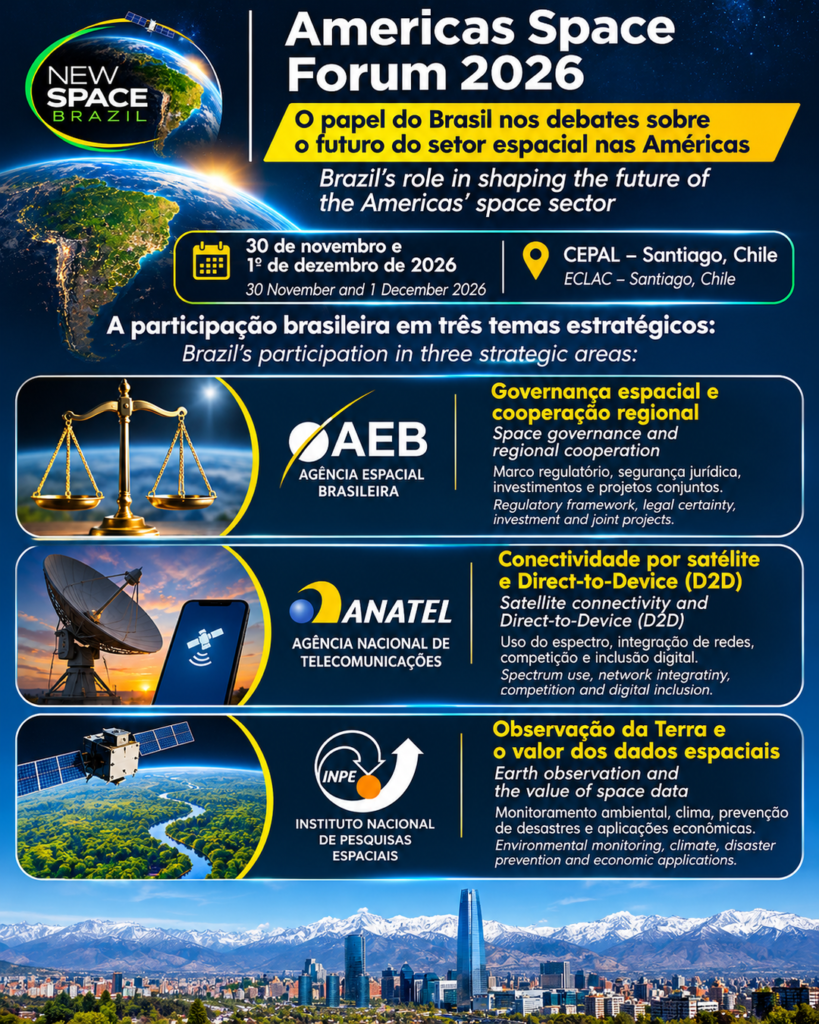
On 30 November and 1 December 2026, Santiago, Chile, will host the Americas Space Forum, an international gathering dedicated to the challenges and opportunities facing the space sector across the Americas.
Following its inaugural edition in Washington, D.C., in 2025, the Forum will make its Latin American debut at the headquarters of the United Nations Economic Commission for Latin America and the Caribbean (ECLAC).
The event will take place alongside a technical advisory mission of the United Nations Office for Outer Space Affairs (UNOOSA), addressing space law and the sustainability of regional space activities.
The programme includes discussions on international cooperation, industrial development, connectivity, investment, space security and defence.
Of particular interest to Brazil is the participation of representatives from three important national institutions: the Brazilian Space Agency (AEB), the National Telecommunications Agency (Anatel) and the National Institute for Space Research (INPE).
AEB: space governance and legal certainty
Brazilian participant: Ian Grosner, Head of Legal Services at the Brazilian Space Agency.
Session 1 — Regional Governance: Building a Continental Space Strategy for the Americas.
Increasing commercial activity in space is prompting countries to modernise their national legislation. Differences between regulatory frameworks, however, can create barriers to international cooperation and commercial development.
Brazil’s participation in this debate is particularly relevant following the adoption of Law No. 14,946/2024, which establishes a legal framework for national space activities.
Ian Grosner has experience in developing Brazil’s space legislation and participating in international discussions on space law.
Why is this important for Brazil?
Brazil’s space sector is undergoing a transformation, with prospects for expanded commercial activities and greater private-sector participation.
Establishing a predictable legal environment is essential to:
- Attract domestic and international investment.
- Facilitate the commercial use of the Alcântara Launch Center.
- Establish responsibilities and requirements for space operators.
- Encourage domestic industry participation.
- Facilitate international projects involving the development and operation of space systems.
Regional regulatory cooperation could reduce administrative complexity without necessarily requiring countries to adopt identical legislation.
Brazil also has an opportunity to contribute to the development of regional approaches to space law, sharing its experience while learning from other markets.
Anatel: direct satellite connectivity to mobile devices
Brazilian participant: Gabriel Carlini Monte da Silva, Telecommunications Regulation Specialist at Anatel.
Session 3 — Direct-to-Device in Focus: The Future of Connectivity in the Americas?
Direct-to-device (D2D) satellite connectivity represents an important evolution in telecommunications.
The technology enables mobile phones, under certain configurations, to communicate directly with satellites, complementing the coverage provided by terrestrial networks.
Anatel’s representative will participate alongside regulators from the United States and Mexico, as well as industry representatives.
Why is this important for Brazil?
Brazil’s continental dimensions, the low population density of certain regions and the difficulties associated with deploying terrestrial infrastructure make satellite connectivity particularly relevant.
Potential applications include communications in rural areas, remote communities, maritime operations, highways and emergency situations.
The availability of technology alone, however, does not guarantee commercial viability or universal access.
Important considerations for Brazil include:
- Efficient use of radiofrequency spectrum.
- Protection of existing services against harmful interference.
- Integration between mobile network and satellite operators.
- Licensing and competitive conditions.
- International frequency coordination and cross-border services.
- Affordability of new services.
The discussion is particularly timely in the context of preparations for the 2027 World Radiocommunication Conference (WRC-27).
International spectrum decisions could significantly influence the conditions under which these services develop in Brazil.
The country’s challenge will be to balance technological innovation, digital inclusion, sustainable competition and the protection of existing telecommunications systems, while recognising the specific characteristics of its domestic market.
INPE: Earth observation and the strategic value of space data
Brazilian participant: Lubia Vinhas, Chief of Staff at the National Institute for Space Research.
Session 4 — Earth Observation, Climate Monitoring and the Strategic Value of Space Data.
Brazil has extensive experience in developing and applying remote-sensing and Earth observation technologies.
Lubia Vinhas brings expertise in geoinformatics, environmental monitoring and space data management, having contributed to initiatives such as Brazil Data Cube and satellite-based monitoring of Brazilian biomes.
The discussion in Santiago will examine opportunities to make more effective use of space-derived information.
Why is this important for Brazil?
Earth observation is an area in which Brazil has established scientific and technological capabilities, with applications of considerable economic and societal significance.
These include:
- Monitoring deforestation in the Amazon and other biomes.
- Precision agriculture and agricultural production monitoring.
- Forest fire monitoring.
- Environmental risk assessment and disaster management support.
- Land-use planning and natural resource management.
- Climate change research.
The next challenge is to increase the value generated by these data, not only for public policy but also for the economy.
Combining satellite imagery with artificial intelligence, cloud computing and geospatial analytics creates opportunities for new businesses, products and services.
International cooperation can also improve data accessibility, reduce duplication of effort and strengthen the region’s technological autonomy.
INPE’s accumulated expertise places Brazil in a position to make a significant contribution to these discussions.
A broader agenda of opportunities
Beyond the sessions involving Brazilian representatives, the Forum will address other topics relevant to Brazil, including strategic autonomy, launch infrastructure, space industry development, financing, workforce development, security and defence.
For Brazil, the opportunity is not simply to follow international trends, but to identify areas where its capabilities can be translated into joint projects, commercial opportunities and new industrial capabilities.
Latin American space cooperation can play an important role in this process, particularly when linked to concrete objectives, financing and identifiable demand.
The challenge: turning capabilities into results
The participation of representatives from AEB, Anatel and INPE in Santiago highlights three complementary dimensions of Brazil’s space sector development: legal certainty, connectivity infrastructure, and scientific and technological capabilities.
Establishing a competitive space economy, however, requires these capabilities to be linked to industrial development, specialised skills, private investment and the creation of sustainable markets.
The Americas Space Forum provides an opportunity to examine these connections within a regional and international context.
The real value of these discussions will lie in the ability to transform experience, proposals and partnerships into initiatives that deliver tangible results for Brazilian industry, the economy and society.
Americas Space Forum 2026
- Dates: 30 November and 1 December 2026.
- Venue: ECLAC headquarters, Santiago, Chile.
- Official programme: https://americasspaceforum.com/
- Event information: https://indico.un.org/event/1025592/
Information on participants and sessions is based on the official programme accessed on 24 November 2026 and is subject to change. The analysis of the topics’ relevance to Brazil is provided by New Space Brazil.