
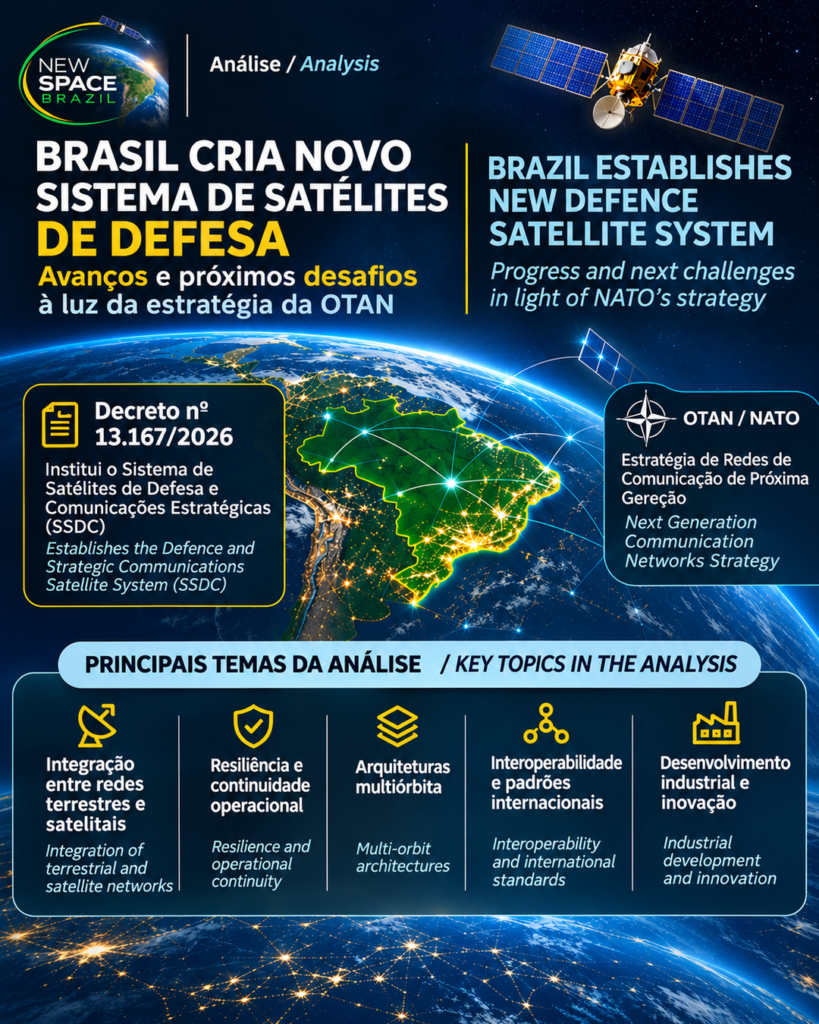
Brazil Establishes New Strategic Satellite System: Progress and Technological Perspectives for the Future
Decree No. 13,167/2026 strengthens the governance of Brazil’s strategic communications. An analysis in light of the trends identified in NATO’s next-generation communications strategy highlights opportunities for technological development, resilience and industrial growth.
New Space Brazil | Analysis | 20 November 2026
A new milestone for Brazil’s strategic communications
The publication of Decree No. 13,167 on 17 November 2026 represents an important institutional step in organizing Brazil’s strategic satellite communications capabilities.
By establishing the Defence and Strategic Communications Satellite System (SSDC), the federal government creates a governance framework designed to meet the requirements of national defence and other government agencies, while supporting the development of Brazil’s satellite communications infrastructure.
The new system incorporates the Geostationary Defence and Strategic Communications Satellite (SGDC-1), launched in 2017, and establishes an institutional foundation for coordinating future projects.
One particularly important development is the transition from a model centred on individual projects towards a governance structure capable of coordinating different initiatives over time.
The decree also brings together institutions with complementary responsibilities: the Ministries of Communications; Defence; Science, Technology and Innovation; and Development, Industry, Trade and Services, alongside Telebras, the Brazilian Space Agency (AEB), the National Institute for Space Research (INPE), the National Telecommunications Agency (Anatel), and organizations within the Brazilian Air Force.
This structure recognizes that strategic communications are not exclusively a technological or military challenge. They also involve industrial policy, telecommunications, scientific development, infrastructure and government coordination.
Brazil’s initiative comes at a time of significant transformation in communications technologies used for security and defence.
One reference for understanding these changes is NATO’s Next Generation Communication Networks Strategy, published in October 2026.
Although developed for a geopolitical and operational context very different from Brazil’s, the strategy offers a perspective on international trends that may influence strategic communications development over the coming decades.
1. Why compare Brazil’s decree with a NATO strategy?
At first glance, comparing a Brazilian strategic communications initiative with a NATO strategy may appear inappropriate. Brazil and the Alliance operate in substantially different geopolitical, institutional and defence environments.
Brazil is a sovereign state with its own security and defence priorities, a tradition of autonomy in foreign policy, and specific technological and industrial development requirements.
NATO, by contrast, is a multinational military alliance organized around collective defence and interoperability among the armed forces of its member countries.
The two documents also serve different purposes.
Brazil’s Decree No. 13,167/2026 establishes an institutional framework for organizing and developing national strategic satellite communications capabilities.
NATO’s strategy presents a broader vision of how communications networks used in security and defence operations are expected to evolve.
The purpose of this analysis is therefore neither to compare Brazil’s military capabilities with NATO’s nor to suggest that Brazil should adopt the Alliance’s geopolitical objectives, institutional structures or operational doctrines.
The relevance of the comparison lies elsewhere: in technology.
NATO’s next-generation communications strategy provides an international reference for understanding the direction in which communications technologies used for security and defence are evolving.
It identifies trends extending beyond the Alliance’s specific requirements, including the convergence of terrestrial and satellite networks, interoperability, cybersecurity, operational resilience and the increasing adoption of emerging technologies.
These developments are not exclusive to NATO. They reflect broader transformations across the global telecommunications industry, with implications for both military and civilian applications.
From this perspective, NATO’s strategy can serve as a technological reference rather than a political or military model to be replicated.
For Brazil, the value lies in understanding how these trends may influence future decisions concerning the SSDC’s architecture, integration, security and industrial development.
Brazil’s decree establishes an important institutional foundation. International technological trends can help identify options for its implementation while fully respecting national priorities, sovereignty and strategic requirements.
2. Converging objectives: autonomy, security and coordination
The first area of convergence is the recognition that reliable communications are essential to national security and the state’s ability to operate effectively.
In Brazil’s case, the decree seeks to organize government satellite infrastructure, strengthen institutional coordination and support domestic technological development.
NATO’s strategy takes a broader operational perspective: ensuring secure, resilient and interoperable communications across different forces, organizations and technologies.
Despite these differences, there is a fundamental shared objective: reducing strategic vulnerabilities and ensuring communications continuity during critical situations.
Brazil also explicitly links operational capabilities with industrial development.
The decree provides for a technology absorption and transfer plan, involving national institutions and guidelines for mobilizing Brazilian industry.
This deserves particular attention.
Operating strategic infrastructure is important, but developing domestic technological expertise, training specialists and expanding national industrial participation can generate benefits extending well beyond individual satellite projects.
3. From satellite infrastructure to integrated networks
One of the principal differences between the documents concerns technological scope.
Brazil’s decree focuses on organizing government satellite systems and their associated ground infrastructure.
NATO’s strategy adopts a next-generation communications perspective encompassing satellites, 5G and 6G mobile networks, optical links, radio systems, terrestrial communications and advanced data-processing capabilities.
Under this approach, communications do not depend exclusively on a single technology. Different networks can complement one another, providing greater flexibility and alternative routes when individual systems become unavailable.
This perspective presents an opportunity for Brazil.
The framework established by the decree could become one component of a broader national architecture integrating government satellites, terrestrial networks and commercial services according to specific security, performance and availability requirements.
This does not mean that the decree itself should necessarily regulate all these technologies.
Its principal contribution is institutional organization. An integrated architecture could be defined through complementary policies and technical instruments, based on the operational requirements of the organizations involved.
4. Opportunities for a multi-orbit approach
Another international trend is the increasing use of different orbital regimes to meet distinct communications requirements.
Geostationary satellites (GEO) remain relevant for wide-area coverage and high-capacity services.
Low Earth orbit (LEO) systems offer different characteristics, particularly regarding latency, mobility and architectural diversity. Medium Earth orbit (MEO) systems can also perform complementary functions.
NATO’s strategy supports a flexible approach combining different technologies and service-delivery models.
Brazil’s decree does not expressly restrict future SSDC satellites to a single orbital regime. By incorporating SGDC-1, it ensures continuity with existing infrastructure while leaving future mission decisions to the governance mechanisms established under the decree.
This flexibility could prove valuable.
In implementing the SSDC, Brazil could evaluate GEO, MEO and LEO architectures, together with combinations of sovereign infrastructure and commercial services, considering national control, security, availability, performance and cost.
The central question is not which orbit should prevail, but which combination best meets Brazil’s strategic requirements.
5. Resilience: beyond satellite availability
Strategic communications must remain operational not only under normal conditions but also during technical failures, natural disasters, cyberattacks and electromagnetic interference.
NATO’s strategy explicitly addresses these threats and the need to develop networks capable of operating in degraded or contested environments.
Brazil’s decree does not establish detailed technical resilience requirements. This should, however, be understood in light of its legal and institutional purpose.
An opportunity for the next stage would be to translate the SSDC’s general objectives into measurable operational requirements.
Areas deserving attention include redundancy across communications links and ground stations, cybersecurity protection, resistance to interference, continuity of critical services and recovery following operational incidents.
It would also be useful to evaluate how government and commercial capabilities could complement one another under exceptional circumstances, while preserving state-defined security and control requirements.
In other words, strategic autonomy must be accompanied by the ability to maintain communications services when they are most needed.
6. Interoperability and international standards
Telecommunications are moving towards increasing integration between terrestrial and non-terrestrial networks, including technologies known as NTN (Non-Terrestrial Networks).
This trend is particularly relevant given the evolution of 3GPP standards, which enable satellite communications functionality to become part of the mobile network ecosystem.
NATO’s strategy recognizes the importance of standardization and interoperability in ensuring that different systems can communicate efficiently and securely.
In Brazil, Anatel’s participation in the technical governance structure established by the decree provides an institutional foundation for considering these issues in future projects.
The involvement of AEB, INPE, Telebras and Air Force organizations could also support a multidisciplinary approach.
A promising direction would be to incorporate interoperability principles, appropriate technological interfaces and compatibility with relevant international standards from the earliest stages of requirements definition.
This could reduce technological dependency risks, facilitate future upgrades and expand opportunities for Brazilian suppliers.
7. Technology transfer as an instrument of industrial development
One of the most important contributions of Brazil’s decree is its explicit attention to technology absorption and transfer.
The decree provides for a plan involving AEB, the Brazilian Air Force Command, INPE and Telebras, including the monitoring of results, intellectual property considerations and participation by Brazilian public and private institutions.
This creates an opportunity to transform future satellite investments into instruments for strengthening Brazil’s industrial and technological base.
International experience demonstrates the importance of linking the acquisition of operational capabilities with the development of engineering, integration, operations and maintenance expertise.
In Brazil’s case, the effectiveness of this mechanism will depend on clearly defined objectives, performance indicators and verifiable commitments.
Beyond transferring documentation or conducting training programmes, the objective should be to progressively expand the country’s ability to design, integrate, operate, maintain and upgrade strategic systems.
NATO’s strategy also recognizes the importance of industry, innovation and intellectual property, although within a cooperation model involving Allied countries and commercial enterprises.
Both documents therefore recognize the close relationship between communications infrastructure and technological and industrial capabilities.
8. Innovation and experimentation: a complementary agenda
A distinguishing element of NATO’s strategy is the use of test environments, technology demonstrations and operational exercises to evaluate new solutions before large-scale adoption.
This approach encompasses emerging technologies such as artificial intelligence, edge computing, autonomous networks and advanced communications applications.
For Brazil, the SSDC could provide an opportunity to bring operational projects closer to research and development activities conducted by public institutions, universities and private companies.
Technology demonstration programmes, interoperability testing and assessments of new architectures could help reduce technical risks and accelerate the adoption of innovative solutions.
The participation of scientific and technological institutions under the decree provides a starting point for this collaboration.
The challenge will be to translate institutional participation into lasting mechanisms for cooperation, experimentation and capability development.
9. Five areas deserving attention during Brazilian implementation
An examination of the two documents identifies five areas that merit attention over the coming years.
1. Integrated communications architecture. Assess how future government satellites can be integrated with terrestrial networks and other strategic infrastructure.
2. Resilience and operational continuity. Establish verifiable requirements for security, redundancy, cybersecurity protection and critical-service availability.
3. Technological flexibility and multi-orbit systems. Consider different satellite architectures and procurement models according to operational needs and sovereignty requirements.
4. Interoperability and standardization. Incorporate relevant international standards and interfaces that facilitate technological evolution.
5. Industrial development and innovation. Link technology transfer to measurable outcomes, domestic skills development and experimentation programmes.
These priorities do not imply replacing the model established by Brazil’s decree. Rather, they could help extend the benefits of its implementation.
Conclusion — A Brazilian institutional foundation for future capabilities
Decree No. 13,167/2026 establishes a new framework for coordinating Brazil’s defence and strategic communications satellite projects.
By bringing institutions together, defining responsibilities and incorporating technology-transfer and industrial-development objectives, it creates an institutional foundation capable of supporting long-term initiatives.
The comparison with NATO’s next-generation communications strategy offers a useful perspective on ongoing technological transformations: integration between terrestrial and space networks, interoperability, resilience, technological flexibility and continuous innovation.
This comparison does not imply that Brazil should replicate international models.
Brazil’s approach should reflect its own priorities concerning sovereignty, security, industrial development and technological autonomy.
The opportunity lies in applying knowledge of evolving communications technologies to develop national solutions appropriate to the country’s strategic requirements.
The next step is not simply to determine which satellites will be developed, but to define how these systems will contribute to a secure, resilient, technologically adaptable national communications infrastructure integrated with other strategic capabilities.
If this evolution is supported by sustained investment, institutional coordination and effective domestic industrial participation, the SSDC could contribute not only to the autonomy of government communications but also to strengthening Brazil’s capabilities in the space sector.
The decree establishes the institutional foundations. The challenge—and opportunity—now lies in translating this framework into lasting technological and operational capabilities.
New Space Brazil — A Brazilian perspective on a global frontier.
Sources and references
1. Brazil — Decree No. 13,167/2026, full text: https://anvisalegis.datalegis.net/action/ActionDatalegis.php?acao=abrirTextoAto&cod_menu=9387&cod_modulo=630&link=S&numeroAto=00013167&orgao=NI&seqAto=000&tipo=DEC&valorAno=2026
2. Brazilian Space Agency — Government establishes the Defence and Strategic Communications Satellite System: https://agenciagov.ebc.com.br/noticias/202611/governo-federal-institui-sistema-de-satelites-de-defesa-e-comunicacoes-estrategicas
3. Ministry of Communications — Governance of Brazilian space projects: https://www.gov.br/mcom/pt-br/noticias/2026/novembro/ministerio-das-comunicacoes-presidira-comite-interministerial-de-projetos-espaciais-no-brasil
4. NATO — Next Generation Communication Networks Strategy, 8 October 2026: https://www.nato.int/en/about-us/official-texts-and-resources/official-texts/2026/10/08/next-generation-communication-networks-strategy