
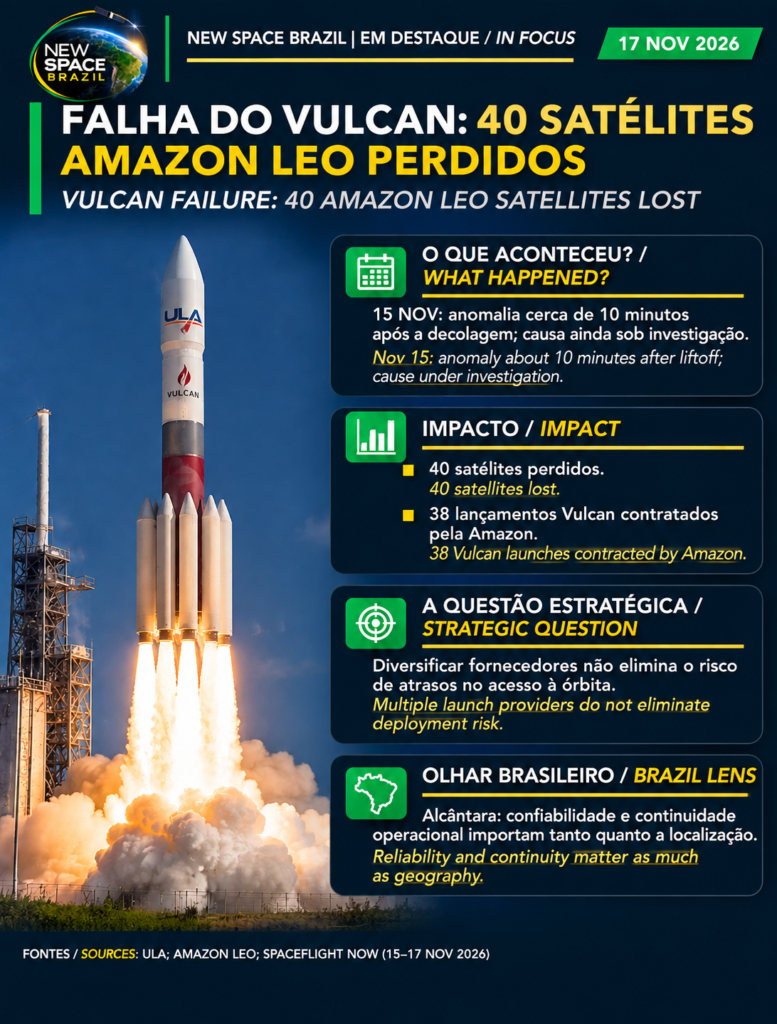
Vulcan Failure Destroys 40 Amazon Leo Satellites and Exposes the Risks of Launch Dependence
17 November 2026 | New Space Brazil
The failure of United Launch Alliance’s Vulcan rocket on 15 November represents a significant setback for both ULA’s commercial launch programme and Amazon Leo’s satellite broadband constellation.
The rocket lifted off from Cape Canaveral carrying 40 Amazon Leo satellites. Approximately ten minutes into the flight, an anomaly prevented the payload from reaching orbit, resulting in the loss of all 40 spacecraft.
Beyond the immediate financial and technical consequences, the incident raises a strategic question: how resilient are large satellite constellation deployment plans when launch capacity depends on several providers, some of which are still developing operational maturity?
What happened during the launch?
The Vulcan Leo 1 mission lifted off on 15 November at 12:40 p.m. Eastern Standard Time. The rocket used six solid rocket boosters alongside its methane-fuelled first-stage engines.
ULA subsequently confirmed that an anomaly approximately ten minutes into flight prevented the mission from reaching orbit.
This was Vulcan’s fifth flight and its first following a roughly nine-month interruption associated with technical reviews of its solid rocket boosters.
Vulcan is intended to replace ULA’s Atlas V and support commercial, institutional and US national security missions.
The cause of the failure has not yet been established. Although flight observations have prompted questions about the vehicle’s performance during stage separation and upper-stage operations, these observations do not constitute a confirmed explanation.
The investigation must distinguish between the initial technical failure and any subsequent effects observed during the mission.
Consequences for Amazon Leo
Amazon Leo, previously known as Project Kuiper, is developing a low Earth orbit broadband constellation intended to compete in the growing satellite connectivity market.
Before the failed mission, Amazon had launched 398 satellites. The additional 40 would have increased that number to 438.
The immediate loss is substantial, but the potential disruption to the deployment schedule may be more consequential.
Amazon has contracted launches from ULA, Arianespace, Blue Origin and SpaceX. Its agreements include 38 Vulcan missions, making ULA an important component of its deployment strategy.
This multi-provider approach is designed to reduce reliance on a single launch system. However, diversification cannot entirely eliminate the risks associated with technical failures, limited launch availability and delays in bringing new rockets into routine service.
If Vulcan faces an extended grounding, Amazon may need to reconsider the sequencing of future missions and the availability of alternative launch opportunities.
Why launch diversification has limits
Orbital launch services are not interchangeable commodities.
Each launch vehicle has distinct payload integration requirements, performance characteristics, safety procedures, ground infrastructure and operational schedules.
Moving satellites from one launch provider to another can involve engineering modifications, contractual changes, additional qualification work and competition for available launch slots.
For large constellations, the challenge is not simply achieving individual successful launches. Operators require a sustained and predictable cadence over several years.
A diversified procurement strategy therefore depends on the reliability and operational maturity of the launch systems involved.
Implications for ULA and the launch market
For ULA, the failure comes during an important transition as Vulcan assumes a growing role in the company’s future launch portfolio.
The investigation could affect commercial and national security launch schedules, depending on the root cause and the corrective measures required.
The incident also highlights broader market constraints.
Demand for launch services is growing, but the number of providers capable of conducting frequent orbital missions remains limited.
When one major vehicle becomes unavailable, customers may face increased competition for launch opportunities elsewhere.
This can have consequences extending beyond the company directly affected.
The Brazil perspective
The Vulcan incident also offers lessons for Brazil’s ambitions to expand commercial launch activity.
Geographical advantages and launch-site infrastructure are important, but they are not sufficient to create a competitive spaceport.
Successful commercial operations require reliable launch vehicles, established safety processes, effective anomaly investigation procedures, regulatory predictability and sustained operational capability.
For Alcântara, long-term competitiveness will depend on bringing these elements together within a commercially viable launch ecosystem.
New Space Brazil analysis
Vulcan’s failure does not invalidate Amazon’s decision to diversify its launch suppliers. Instead, it demonstrates both the importance and the limitations of that strategy.
For satellite constellation operators, dependable access to orbit has become a strategic requirement alongside spacecraft manufacturing and network development.
The immediate technical consequences will depend on ULA’s investigation. The wider commercial implications could extend well beyond the return-to-flight decision.
The central lesson is that launch capacity must be measured not only by contracted missions, but also by demonstrated reliability, operational readiness and the ability to sustain a predictable schedule.